
The Longevity Blue Book Series
Why Human Health Is a System—Not a Collection of Separate Organs
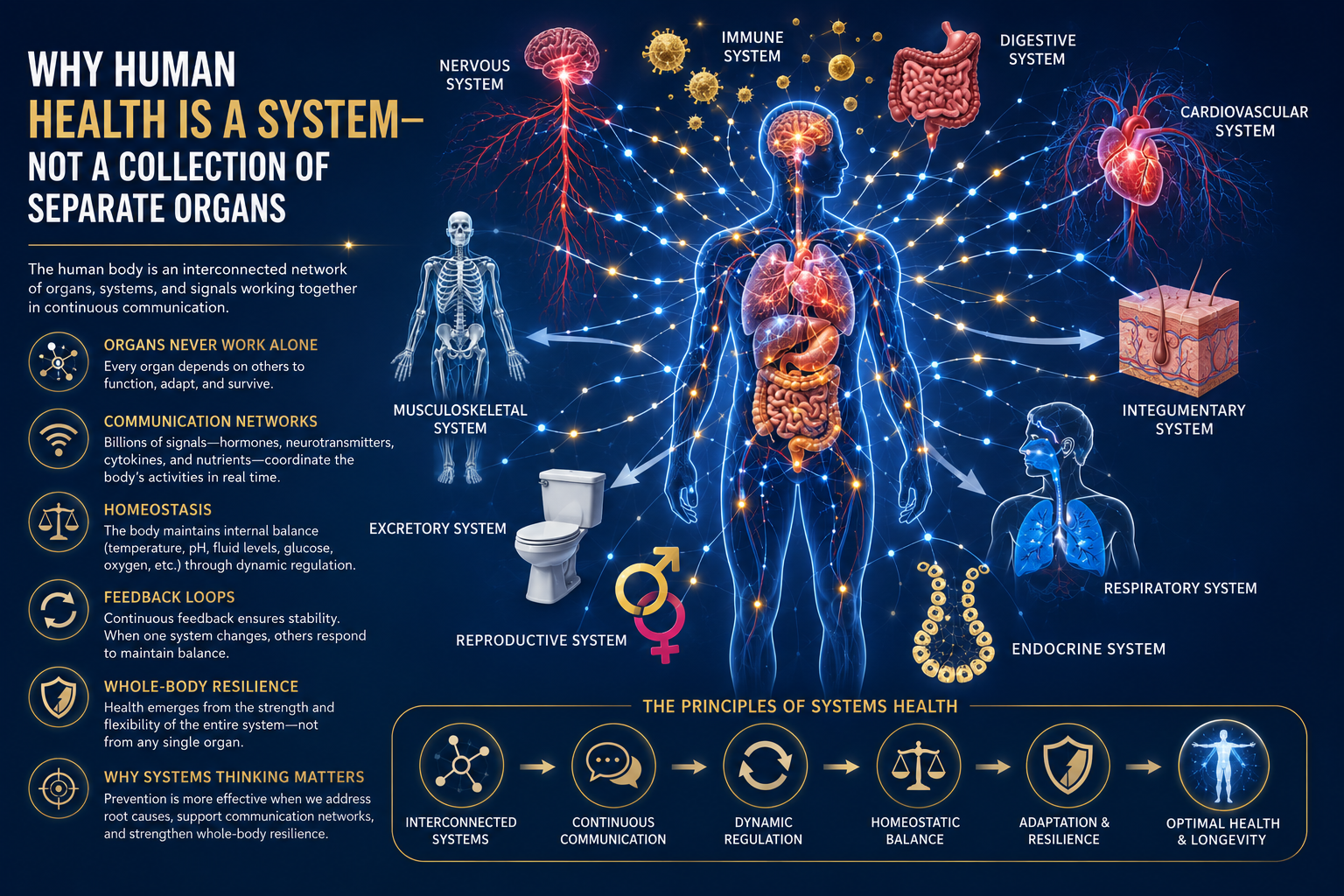
Modern biology has transformed our understanding of human health. Rather than functioning as isolated parts, every organ belongs to an integrated network that continuously exchanges information, energy, nutrients, hormones, and biochemical signals. The brain communicates with the heart, the gut influences the immune system, muscles regulate metabolism, and hormones coordinate activities throughout the entire body. Health emerges from these dynamic interactions—not from any single organ working alone.
Systems biology examines these complex communication networks to explain how the body maintains homeostasis, the stable internal environment necessary for survival. Through countless feedback loops, changes in one system immediately trigger adaptive responses in others. For example, fluctuations in blood sugar influence insulin release, energy production, appetite regulation, and even brain function. Likewise, chronic inflammation, poor sleep, or persistent stress can ripple through multiple biological systems simultaneously.
Whole-body resilience depends on the strength of these interconnected networks. When communication remains efficient, the body adapts to challenges, repairs damage, and maintains physiological balance. When communication becomes disrupted, seemingly unrelated symptoms may appear across multiple organs long before disease develops.
This systems perspective is increasingly important in preventive medicine. Instead of treating organs individually after problems arise, systems thinking focuses on maintaining healthy biological networks, identifying early imbalances, and supporting the body’s natural ability to adapt. By understanding how organs cooperate rather than compete, we gain a more complete picture of health, longevity, and disease prevention.
Focus
Introduce systems biology.
Topics
- Why organs never work alone
- Communication networks
- Homeostasis
- Feedback loops
- Whole-body resilience
- Why systems thinking matters for prevention
Before exploring any health strategy or wellness product, it’s helpful to understand how the body’s systems work together rather than in isolation. A systems biology perspective explains why metabolism, the brain, hormones, immunity, circulation, sleep, and recovery continuously influence one another. By recognizing these biological connections, you can better evaluate health information, identify preventive opportunities, and make more informed decisions based on how the entire body functions as an integrated system—not as a collection of separate organs.