
The Weight-Loss Myth: It’s Not Just About Willpower

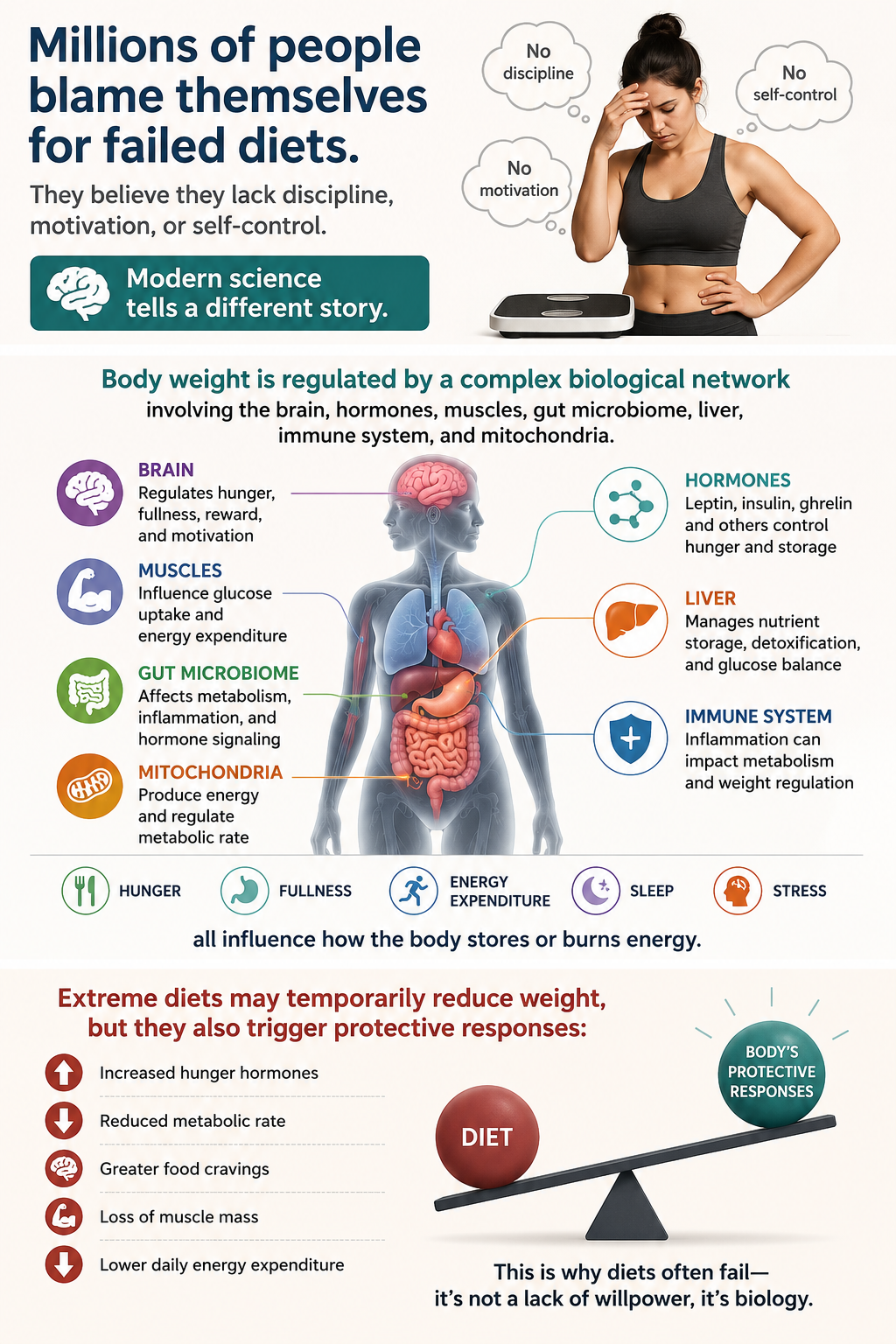
Millions of people blame themselves for failed diets.
They believe they lack discipline, motivation, or self-control.
Modern science tells a different story.
Body weight is regulated by a complex biological network involving the brain, hormones, muscles, gut microbiome, liver, immune system, and mitochondria. Hunger, fullness, energy expenditure, sleep, and stress all influence how the body stores or burns energy.
Extreme diets may temporarily reduce weight, but they also trigger protective responses:
• Increased hunger hormones
• Reduced metabolic rate
• Greater food cravings
• Loss of muscle mass
• Lower daily energy expenditure
The body is designed to survive scarcity, making rapid weight loss difficult to maintain.
Successful long-term fat loss is usually achieved through consistent lifestyle changes rather than dramatic restriction.
A metabolism reset is not about forcing the body to lose weight.
It is about creating an environment where healthy metabolism naturally supports sustainable fat loss.
Understanding Why Diets Often Fail: A Systems Biology Perspective on Weight Regulation
(Approximately 600 words)
For decades, millions of people have believed that unsuccessful weight loss is primarily the result of insufficient willpower, poor self-control, or a lack of motivation. Popular culture has reinforced the idea that losing weight is simply a matter of eating less and exercising more. However, advances in modern physiology, endocrinology, neuroscience, and systems biology have revealed that body weight regulation is far more complex than a simple balance between calories consumed and calories burned.
Human metabolism operates as an integrated biological network in which multiple organs and physiological systems communicate continuously to maintain energy balance and survival. The brain serves as the central control center, receiving signals from hormones, nutrients, the digestive tract, and other tissues to determine hunger, satiety, motivation, and energy expenditure. Rather than allowing unlimited weight loss, the body is biologically programmed to defend its energy stores, particularly during periods of perceived food scarcity.
Hormones play a major role in this regulatory process. Leptin, produced primarily by fat tissue, informs the brain about long-term energy reserves, while ghrelin, released mainly from the stomach, stimulates hunger before meals. Insulin helps regulate glucose metabolism and nutrient storage, while numerous additional hormones coordinate digestion, stress responses, and energy utilization. These signaling molecules continuously interact, forming a sophisticated communication network that influences appetite, food preferences, and metabolic efficiency.
Muscle tissue also contributes significantly to metabolic health. Skeletal muscles account for a large proportion of daily energy expenditure and serve as the primary site for glucose disposal following meals. Maintaining healthy muscle mass supports metabolic flexibility, insulin sensitivity, and long-term energy balance. During aggressive calorie restriction, however, muscle tissue may be lost alongside body fat, reducing resting metabolic rate and making continued weight loss progressively more difficult.
The gut microbiome has emerged as another important regulator of metabolism. Trillions of microorganisms living within the digestive tract participate in nutrient processing, immune regulation, production of beneficial metabolites, and communication with the brain through the gut-brain axis. Dietary patterns, medications, sleep quality, and lifestyle habits all influence microbial diversity, which in turn may affect appetite regulation, inflammation, and metabolic health.
The liver functions as the body’s central metabolic processing center. It regulates glucose storage and release, synthesizes lipids, detoxifies harmful substances, and coordinates numerous biochemical pathways involved in maintaining energy homeostasis. At the same time, the immune system contributes by regulating inflammatory responses. Chronic low-grade inflammation, commonly associated with obesity and metabolic dysfunction, can interfere with insulin signaling and disrupt normal metabolic regulation.
Within nearly every cell, mitochondria generate the energy required to sustain life. These cellular powerhouses convert nutrients into adenosine triphosphate (ATP), supporting movement, organ function, tissue repair, and countless biochemical reactions. Reduced mitochondrial efficiency may contribute to fatigue, impaired metabolic flexibility, and decreased energy expenditure, illustrating how cellular function influences whole-body physiology.
Importantly, body weight is also influenced by behavioral and environmental factors that interact with these biological systems. Sleep deprivation alters hunger hormones, increasing appetite while reducing satiety. Chronic psychological stress activates the hypothalamic-pituitary-adrenal (HPA) axis, elevating cortisol levels that may promote fat storage and increase cravings for calorie-dense foods. Physical inactivity reduces muscle activity and daily energy expenditure, while highly processed foods may disrupt normal appetite regulation.
Extreme dieting often triggers powerful biological defense mechanisms designed to preserve survival. As calorie intake falls dramatically, hunger hormones increase, resting metabolic rate decreases, spontaneous physical activity often declines, food cravings become stronger, and muscle mass may gradually diminish. These adaptive responses evolved to protect humans during periods of famine but now make sustained weight loss significantly more challenging in modern environments.
Understanding these interconnected physiological systems helps explain why many traditional dieting approaches produce only temporary results. Long-term metabolic health is more likely to be supported by comprehensive lifestyle strategies that combine balanced nutrition, regular physical activity, adequate protein intake, resistance training, restorative sleep, stress management, and sustainable behavioral habits. Rather than viewing obesity or weight regain as a personal failure, a systems-based perspective recognizes that body weight emerges from the continuous interaction of biological, environmental, behavioral, and psychological factors. Appreciating this complexity provides a more realistic, compassionate, and scientifically grounded framework for improving metabolic health and supporting healthy aging over the long term.
Before choosing any weight management program, supplement, or diet plan, it helps to understand how the body’s metabolic systems actually work. Sustainable weight management is rarely determined by willpower alone—it reflects the coordinated interaction of the brain, hormones, muscles, gut microbiome, liver, immune function, mitochondria, sleep, nutrition, and daily lifestyle habits. Explore the science first, then evaluate which evidence-based strategies may best support long-term metabolic health rather than short-term weight loss.
Explore Science-Based Guides for Preventive metabolism Care and Healthy