
The Connection Between Hearing and Brain Health
The ears collect sound—but the brain creates hearing.
Every conversation requires remarkable coordination between multiple brain regions that process language, memory, attention, and auditory information simultaneously.
Healthy hearing therefore depends on:
- Efficient neural communication
- Healthy blood circulation
- Mitochondrial energy production
- Neuroplasticity
- Cognitive processing
- Adequate sleep
- Balanced stress responses
When hearing becomes more difficult, the brain must work harder to interpret incomplete sound information. This increased listening effort may contribute to mental fatigue during long conversations or noisy social environments.
The Brain Creates Hearing: Why Healthy Hearing Depends on the Entire Nervous System
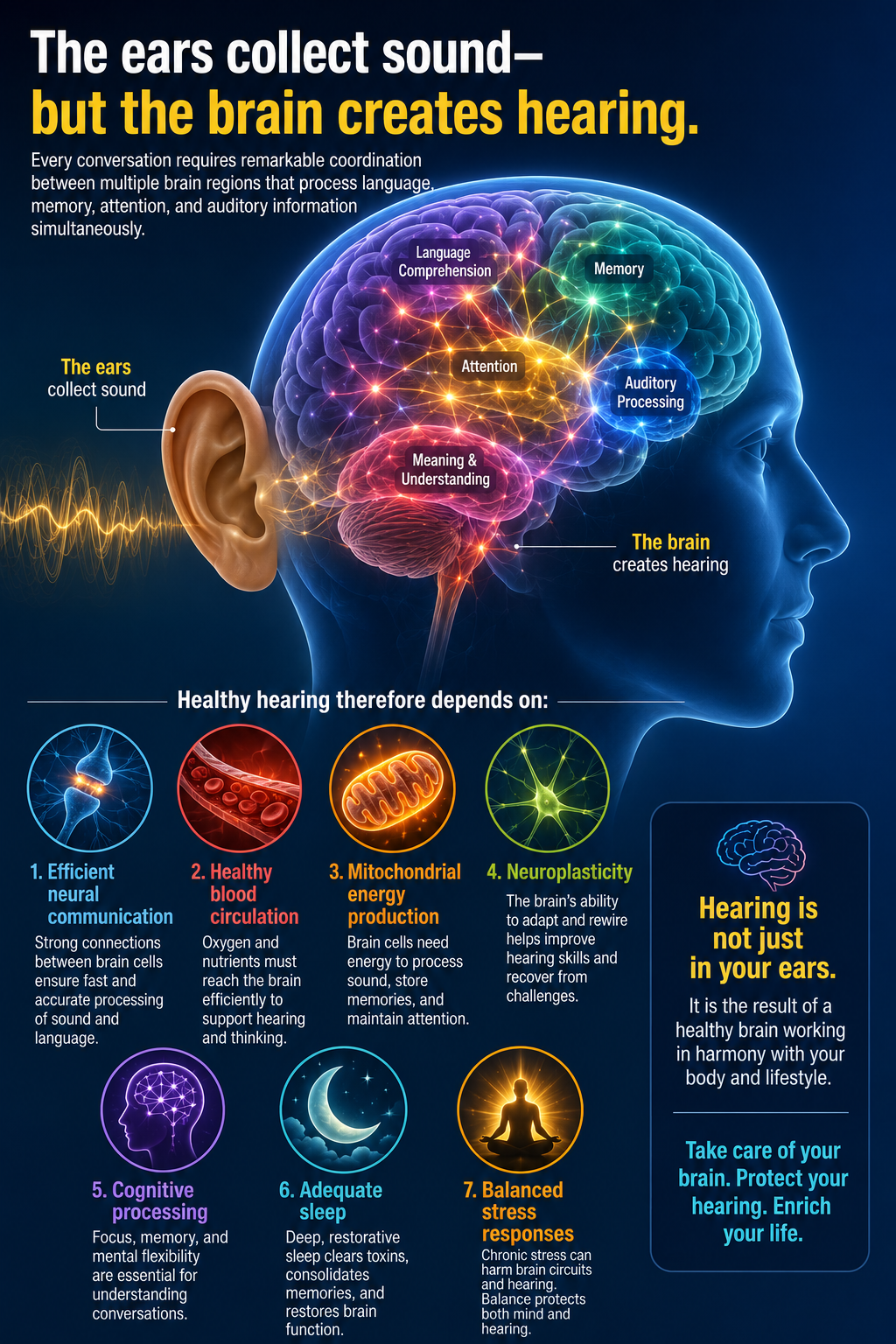
Most people think hearing happens in the ears. In reality, the ears simply capture sound waves and convert them into electrical signals. The true experience of hearing is created inside the brain, where millions of neurons work together to interpret speech, recognize familiar voices, filter background noise, and assign meaning to every sound we hear.
This remarkable process occurs within fractions of a second. As sound enters the ear, tiny sensory hair cells inside the cochlea transform mechanical vibrations into nerve impulses. These signals travel through the auditory nerve to multiple regions of the brain, including the brainstem, thalamus, auditory cortex, language centers, attention networks, and memory systems. Rather than functioning as isolated structures, these regions operate as an integrated communication network.
Because hearing depends on this complex biological system, maintaining healthy hearing involves far more than protecting the ears alone.
Efficient neural communication is one of the foundations of healthy hearing. Billions of neurons exchange information through specialized connections called synapses, allowing sound signals to be transmitted rapidly and accurately. When communication between these networks slows or becomes disrupted, the brain may require more effort to understand conversations, particularly in noisy environments.
Healthy circulation also plays an essential role. The auditory system is highly dependent on a continuous supply of oxygen and nutrients delivered through the bloodstream. Even subtle reductions in blood flow may influence the function of the delicate structures within the inner ear and the brain regions responsible for processing sound. Lifestyle habits that support cardiovascular health—including regular physical activity, blood pressure management, and balanced nutrition—may also contribute to maintaining auditory function throughout life.
Another critical factor is mitochondrial energy production. Hearing is an energy-intensive process. Every electrical impulse generated by nerve cells requires adenosine triphosphate (ATP), the body’s primary energy currency. Mitochondria, often called the powerhouses of the cell, provide this energy for both the auditory system and the brain. Healthy mitochondrial function supports efficient communication between neurons and helps sustain the high metabolic demands of continuous sound processing.
The brain’s ability to adapt, known as neuroplasticity, is equally important. Neural pathways constantly reorganize in response to learning, experience, and sensory input. This adaptability enables people to recognize new voices, learn different languages, adjust to hearing devices, and compensate for minor changes in hearing over time. Research suggests that maintaining an active, intellectually stimulating lifestyle may help preserve this adaptive capacity as people age.
Cognitive processing further shapes the listening experience. Hearing is not simply detecting sounds—it is understanding them. Attention, working memory, language comprehension, and executive function all contribute to successful communication. This explains why individuals with healthy hearing sensitivity may still struggle to follow conversations when cognitive resources are reduced by fatigue, distraction, or aging.
Sleep is another often-overlooked contributor to auditory health. During restorative sleep, the brain consolidates memories, regulates neurotransmitters, removes metabolic waste products, and restores neural function. Poor sleep may reduce attention, slow information processing, and make listening feel more mentally exhausting the following day.
Stress also influences hearing through multiple biological pathways. Chronic activation of the stress response increases circulating stress hormones, alters autonomic nervous system activity, and may affect blood flow and neural signaling. Persistent stress can make it more difficult for the brain to focus on important sounds while filtering competing background noise. Stress management strategies—including mindfulness, physical activity, relaxation techniques, and sufficient recovery time—may therefore support both cognitive performance and healthy auditory processing.
Modern neuroscience increasingly recognizes that hearing reflects the coordinated performance of an entire biological network rather than a single organ. The ears capture sound, but the brain transforms those signals into language, music, emotion, and meaningful human connection. Protecting hearing throughout life therefore involves caring for the nervous system, cardiovascular system, metabolism, sleep, and overall lifestyle. By supporting these interconnected systems, we also support one of our most valuable abilities—the capacity to communicate, learn, and remain connected with the world around us.
Researchers continue exploring relationships between hearing, cognitive function, social engagement, and healthy aging. While hearing changes do not directly cause cognitive decline, maintaining auditory health may help support communication, mental stimulation, and overall quality of life.
From Sound to Understanding: The Brain’s Hearing Network

This conceptual illustration emphasizes that hearing is fundamentally a brain function rather than an ear function. Although the ears capture sound waves from the environment, the experience of hearing emerges only after the brain interprets those incoming signals through a highly coordinated network of neural pathways. The futuristic scenes portray an individual at rest while complex patterns of light, neural circuits, and interconnected brain structures symbolize continuous information processing occurring beneath conscious awareness.
The glowing networks surrounding the brain represent the remarkable communication between the auditory cortex, language centers, attention systems, memory circuits, and emotional processing regions. Every spoken word, musical note, or environmental sound must be rapidly analyzed, compared with stored memories, filtered from background noise, and assigned meaning within milliseconds. This extraordinary biological computation requires healthy neurons, efficient synaptic communication, adequate blood flow, sufficient mitochondrial energy production, and intact neuroplasticity.
The cool blue tones evoke a sense of cognitive activity, restoration, and neurological precision, suggesting that healthy hearing depends not only on the ears but also on overall brain health. Sleep, stress regulation, cardiovascular function, metabolism, and lifelong learning all contribute to maintaining these intricate neural networks. The illustration reinforces a systems biology perspective: hearing is the product of the entire brain working in harmony with the body, transforming simple sound waves into language, memory, emotion, and meaningful human connection.
The Hearing Support Blueprint explores these connections through an educational, evidence-informed perspective.
Hearing health is not just about the ears—it is an important part of protecting brain function, communication, independence, and quality of life. Discover how preventive choices can support long-term sensory resilience.