
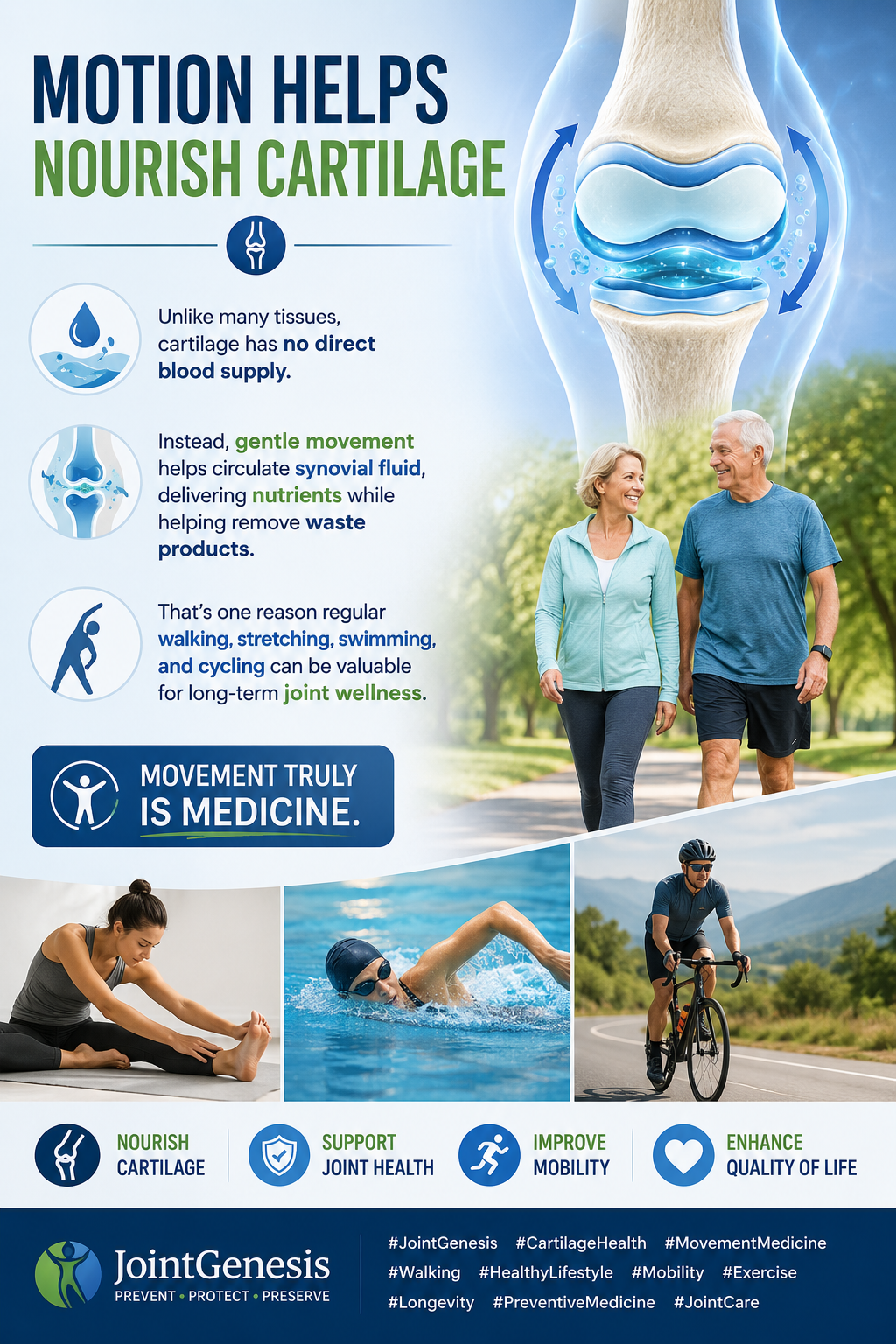
Motion Helps Nourish Cartilage
Unlike many tissues, cartilage has no direct blood supply.
Instead, gentle movement helps circulate synovial fluid, delivering nutrients while helping remove waste products.
That’s one reason regular walking, stretching, swimming, and cycling can be valuable for long-term joint wellness.
Movement truly is medicine.
Why Movement Matters for Cartilage Health
Many people think that cartilage simply wears out with age, much like the tread on a tire. Modern research, however, shows that cartilage is a living tissue that continuously responds to its biological environment. While aging, injury, genetics, and certain medical conditions all influence joint health, everyday movement plays an essential role in helping cartilage remain as healthy as possible throughout life.
One of the most fascinating features of cartilage is that it has no direct blood supply. Unlike muscles, skin, or many internal organs, cartilage does not receive nutrients through a network of blood vessels. Instead, it depends largely on synovial fluid—the specialized lubricating fluid found within healthy joints. This fluid not only reduces friction between joint surfaces but also transports oxygen, nutrients, and other important molecules to cartilage cells while helping remove metabolic waste products.
Movement is the driving force behind this remarkable process. During activities such as walking, stretching, cycling, swimming, or simply bending and straightening a joint, gentle compression and relaxation create a pumping effect within the joint. This natural mechanical motion encourages synovial fluid to circulate across the cartilage surface, improving the exchange of nutrients and waste products. In many ways, movement serves as the joint’s own internal circulation system.
Healthy cartilage also responds positively to appropriate mechanical loading. Moderate, regular physical activity stimulates cartilage cells, known as chondrocytes, to maintain the extracellular matrix that provides cartilage with its strength, flexibility, and shock-absorbing capacity. This matrix contains important structural components such as collagen fibers and proteoglycans, which help cartilage resist compression during daily activities.
In contrast, prolonged inactivity may reduce this beneficial stimulation. Extended periods of sitting or immobilization can decrease synovial fluid circulation and may contribute to joint stiffness. This is one reason many people notice that their joints feel tighter after sitting for long periods but often become more comfortable after gentle movement.
Not all exercise affects joints in the same way. High-impact activities may place excessive stress on vulnerable joints in some individuals, particularly those recovering from injury or living with advanced osteoarthritis. Fortunately, numerous low-impact exercises provide significant benefits while minimizing unnecessary joint strain.
Walking remains one of the simplest and most accessible forms of movement. It promotes joint lubrication, strengthens surrounding muscles, improves circulation, and supports overall mobility. Swimming and water-based exercise reduce weight-bearing forces while allowing joints to move freely through a comfortable range of motion. Cycling provides rhythmic movement that helps nourish knee and hip cartilage while improving muscular endurance. Stretching and mobility exercises help preserve flexibility and support healthy movement patterns.
The muscles surrounding each joint are equally important. Strong muscles absorb part of the mechanical forces generated during daily activities, reducing stress placed directly on cartilage. Resistance training performed with proper technique can therefore complement aerobic exercise as part of a comprehensive joint wellness program.
Body weight also influences cartilage health. Maintaining a healthy weight reduces repetitive loading on weight-bearing joints such as the knees, hips, and ankles. Even modest reductions in excess body weight may decrease joint stress during walking and other routine activities while supporting long-term mobility.
Joint health is influenced by many interconnected biological systems beyond cartilage alone. Adequate sleep supports tissue recovery. Balanced nutrition provides the building blocks for normal cellular function. Healthy metabolic regulation, effective circulation, appropriate inflammation balance, and regular physical activity all contribute to the environment in which joints function. This systems-based perspective reminds us that protecting mobility involves caring for the entire body rather than focusing on a single tissue.
Although no single exercise or supplement can completely prevent age-related joint changes, consistent daily movement remains one of the most effective lifestyle strategies for supporting lifelong joint function. Every walk, every stretch, every swim, and every bicycle ride helps keep synovial fluid moving, nourishes cartilage, supports surrounding muscles, and encourages healthy mobility.
Movement truly is medicine—not because it cures every condition, but because it continuously supports the remarkable biological systems that allow our joints to move comfortably throughout life.
#JointGenesis #CartilageHealth #MovementMedicine #Walking #HealthyLifestyle #Mobility #Exercise #Longevity #PreventiveMedicine #JointCare
Walking Together: A Lifelong Journey Toward Healthy Aging

This illustration beautifully captures walking as a symbol of lifelong health, resilience, and human connection. Across the four panels, people of different ages, backgrounds, and body types move forward together, reminding us that healthy movement is one of the most universal and accessible habits for promoting long-term well-being.
Walking is far more than a form of transportation or exercise. It is a whole-body activity that engages the musculoskeletal, cardiovascular, respiratory, metabolic, and nervous systems simultaneously. Each step stimulates blood circulation, supports joint lubrication through synovial fluid movement, strengthens muscles that stabilize the joints, and helps maintain balance and coordination. Regular walking may also improve insulin sensitivity, cardiovascular fitness, mood, sleep quality, and cognitive function.
The artwork also highlights an important message: movement is for everyone. Whether young or old, athletic or beginning a wellness journey, individuals can benefit from incorporating more daily movement into their routines. Walking requires no expensive equipment and can often be adapted to different fitness levels and physical abilities.
From a preventive medicine perspective, consistent walking represents one of the simplest yet most powerful lifestyle interventions available. Small daily steps, repeated over months and years, contribute to healthier joints, stronger muscles, improved mobility, and greater independence. In many ways, every walk is an investment in healthier aging, helping people maintain vitality, resilience, and quality of life throughout every stage of adulthood.
Start protecting your mobility today — one small step can support stronger joints, better movement, and healthier aging.