
Why Dieting Often Slows Fat Loss
Many people respond to weight gain by eating dramatically less.
Unfortunately, the body often interprets severe calorie restriction as a survival threat.
Adaptive responses may include:
Lower resting metabolic rate
Reduced spontaneous movement
Greater hunger
Higher food reward sensitivity
Why Eating Less Is Not Always the Answer: Understanding Adaptive Thermogenesis
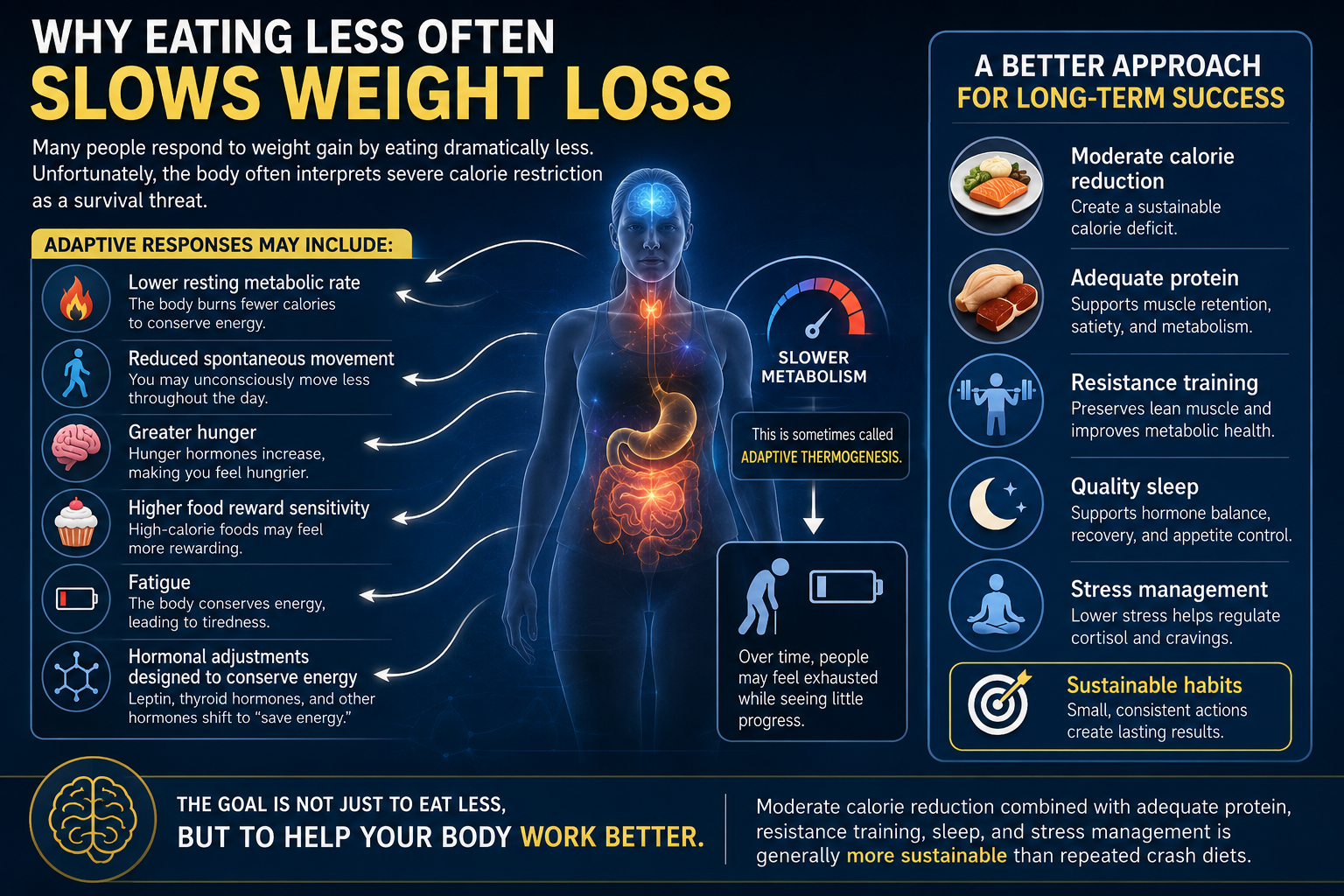
When weight gain occurs, many people instinctively believe the fastest solution is to eat as little as possible. While creating a calorie deficit is an important component of weight management, severe calorie restriction can trigger a series of biological adaptations that make long-term weight loss more difficult. The human body has evolved sophisticated survival mechanisms designed to protect against famine, and these mechanisms can become active when energy intake drops dramatically.
One of the most important concepts in modern metabolism research is adaptive thermogenesis. This refers to the body’s tendency to reduce energy expenditure during prolonged calorie restriction. In simple terms, the body becomes more efficient, burning fewer calories than expected in an effort to conserve energy. Although this response helped our ancestors survive periods of food scarcity, it can frustrate people attempting to lose weight through extreme dieting.
As calorie intake declines substantially, resting metabolic rate may decrease. The body requires less energy to maintain basic functions such as breathing, circulation, temperature regulation, and cellular maintenance. At the same time, many individuals unconsciously move less throughout the day. Everyday activities such as walking, standing, changing posture, or fidgeting—collectively known as non-exercise activity thermogenesis (NEAT)—often decline without conscious awareness. These seemingly small reductions in movement can significantly decrease total daily calorie expenditure.
Severe dieting also affects appetite regulation. Hormones involved in hunger and fullness begin to shift in ways that encourage food intake. Hunger often increases, while feelings of fullness become weaker after meals. Foods rich in sugar and fat may appear even more rewarding because the brain’s reward pathways become more sensitive during energy deprivation. These biological changes are not signs of weak willpower—they represent normal survival responses designed to restore energy balance.
Fatigue is another common consequence of aggressive calorie restriction. As available energy decreases, people frequently experience lower physical performance, reduced exercise capacity, impaired concentration, and decreased motivation for daily activities. This reduction in energy can further limit physical activity, making sustained weight loss increasingly challenging.
Hormonal adjustments also contribute to metabolic adaptation. Research suggests that prolonged energy restriction may influence thyroid hormone activity, leptin levels, reproductive hormones, and stress hormones. Together, these changes help the body conserve energy while prioritizing essential physiological functions. Although these adaptations vary among individuals, they illustrate how interconnected the body’s metabolic systems truly are.
Fortunately, successful weight management rarely depends on eating as little as possible. Instead, evidence increasingly supports a balanced, sustainable approach that protects metabolic health while gradually reducing body fat. Moderate calorie reduction is generally more effective over the long term because it creates a manageable energy deficit without triggering the strongest survival responses.
Adequate protein intake plays an essential role in this strategy. Protein helps preserve lean muscle mass during weight loss, supports recovery after exercise, promotes satiety, and requires more energy to digest than carbohydrates or fats. Maintaining muscle is particularly important because skeletal muscle is one of the body’s most metabolically active tissues.
Resistance training further enhances this process by helping preserve or build muscle while encouraging favorable metabolic adaptations. Combined with regular aerobic activity, strength training supports energy expenditure, functional health, and long-term weight maintenance.
Quality sleep is another often-overlooked factor. Insufficient sleep has been associated with increased hunger, impaired glucose regulation, reduced recovery, and greater cravings for highly processed foods. Similarly, chronic psychological stress may elevate cortisol levels, influence eating behaviors, and interfere with healthy metabolic regulation.
Ultimately, healthy weight management is not about fighting the body’s biology—it is about working with it. Sustainable progress typically results from consistent habits rather than repeated cycles of extreme restriction. Balanced nutrition, regular physical activity, sufficient protein, restorative sleep, effective stress management, and patience allow the body’s complex metabolic systems to function more efficiently over time. Lasting success is built through small, sustainable changes that support overall health, not through crash diets that trigger the body’s natural defenses.
Hormonal adjustments designed to conserve energy
This is sometimes called adaptive thermogenesis.
Over time, people may feel exhausted while seeing little progress.
Moderate calorie reduction combined with adequate protein, resistance training, sleep, and stress management is generally more sustainable than repeated crash diets.
Consistency Usually Outperforms Intensity
This illustration presents the human body as a dynamic biological system rather than a collection of isolated organs. Glowing pathways connect the brain, heart, lungs, digestive system, endocrine glands, and metabolic networks, emphasizing that long-term health is built through continuous communication among interconnected systems. The surrounding charts, biomarkers, and digital interfaces reinforce the concept that sustainable wellness depends on monitoring and supporting the entire body over time.
The central message is that meaningful health improvements rarely come from extreme efforts or short bursts of motivation. Instead, they arise from small, repeatable behaviors practiced consistently. Daily movement, balanced nutrition, restorative sleep, stress management, hydration, and regular preventive care gradually strengthen the body’s ability to adapt, recover, and maintain physiological balance. Each healthy decision contributes a small benefit, and over weeks, months, and years these benefits accumulate into significant improvements in metabolic function, cardiovascular health, cognitive performance, immune resilience, and healthy aging.
The futuristic systems-biology design also reflects the growing role of precision health, where biomarkers and personalized data help guide informed lifestyle choices. Rather than focusing on isolated symptoms, the visual encourages a whole-body perspective in which every healthy habit influences multiple biological pathways simultaneously.
Ultimately, the artwork illustrates a timeless principle of preventive medicine: consistency usually outperforms intensity. Sustainable daily habits create stronger foundations for lifelong vitality than occasional extreme interventions, making gradual progress the most reliable path toward lasting health and longevity.
Mindfulness: Your Secret Tool for Better Nutrition

This cheerful illustration highlights the power of mindfulness in creating a healthier relationship with food. A calm individual sits in meditation while tempting foods gently float around, symbolizing that cravings and impulses can be observed without immediately acting on them. Rather than relying on strict restriction or willpower alone, mindful awareness encourages thoughtful choices that align with long-term health goals. Practicing techniques such as deep breathing, slowing down during meals, and recognizing emotional triggers may help reduce mindless eating and improve self-regulation. Over time, these small, consistent habits can support healthier eating patterns, greater emotional balance, and sustainable weight management. Lasting wellness is often built through awareness, patience, and daily practice rather than perfection.
Before choosing any weight management program, supplement, or diet plan, it helps to understand how the body’s metabolic systems actually work. Sustainable weight management is rarely determined by willpower alone—it reflects the coordinated interaction of the brain, hormones, muscles, gut microbiome, liver, immune function, mitochondria, sleep, nutrition, and daily lifestyle habits. Explore the science first, then evaluate which evidence-based strategies may best support long-term metabolic health rather than short-term weight loss.