
Understanding Tinnitus: Causes, Brain Mechanisms, and Management
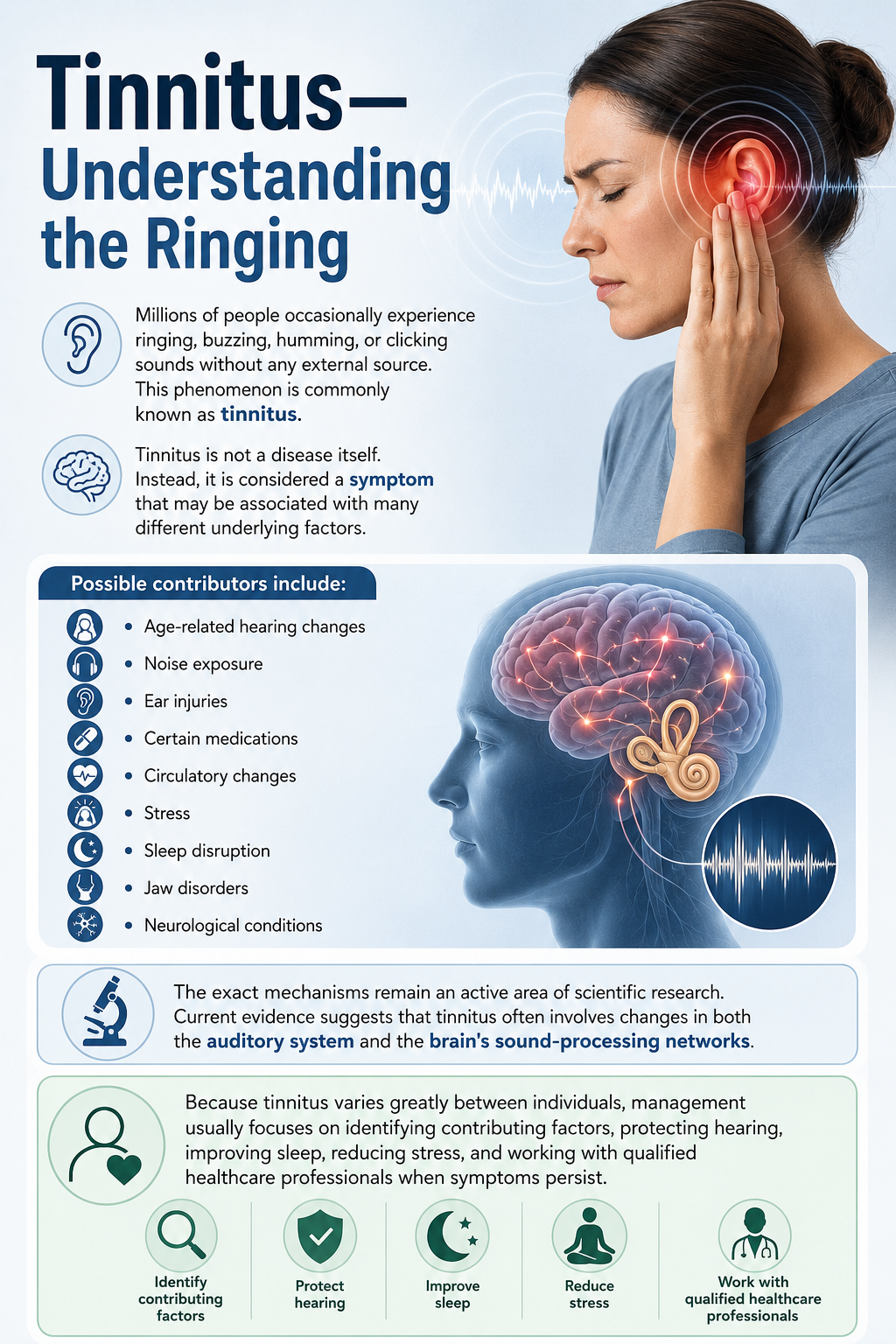
Many people experience a persistent ringing, buzzing, humming, hissing, or clicking sound that seems to come from inside the ears rather than from the surrounding environment. This phenomenon is known as tinnitus, and it affects millions of people worldwide. For some individuals, the sound is occasional and barely noticeable. For others, it can become persistent enough to interfere with concentration, sleep, emotional well-being, and overall quality of life.
Importantly, tinnitus is not a disease itself. Instead, healthcare professionals generally consider it a symptom that may be associated with a wide variety of underlying conditions affecting the ears, the auditory nervous system, or other parts of the body. Because the causes differ greatly from person to person, understanding tinnitus requires a comprehensive, systems-based perspective rather than searching for a single explanation.
One of the most common contributors is age-related hearing loss. As people grow older, the delicate sensory hair cells inside the inner ear gradually decline in both number and function. These microscopic cells normally convert sound vibrations into electrical signals that travel to the brain. When they become damaged or lost, the brain may compensate by increasing activity within auditory pathways, potentially contributing to the perception of phantom sounds.
Noise exposure is another major risk factor. Long-term exposure to loud music, industrial machinery, firearms, concerts, construction equipment, or personal listening devices at high volume can injure the sensitive structures of the inner ear. Even a single episode of extremely loud noise may trigger temporary or permanent tinnitus in some individuals. Wearing appropriate hearing protection remains one of the most effective preventive strategies.
Several other factors may also contribute, including ear infections, earwax blockage, head or neck injuries, temporomandibular joint (TMJ) disorders, certain medications, circulatory changes, neurological conditions, and metabolic health issues. In some cases, tinnitus appears to fluctuate with stress levels, fatigue, poor sleep, or changes in emotional health, suggesting that multiple body systems interact to influence symptom severity.
Modern neuroscience has transformed our understanding of tinnitus. Researchers now recognize that the condition often involves both the ear and the brain. When normal auditory signals decrease because of hearing loss or other changes, the brain’s sound-processing networks may reorganize themselves in ways that increase spontaneous neural activity. This altered activity may then be interpreted as ringing or buzzing, even when no external sound exists. Scientists continue investigating how attention, memory, emotion, and neural plasticity influence these processes.
Although tinnitus can sometimes be frustrating, many people successfully reduce its impact through a combination of supportive management strategies. Protecting hearing from excessive noise, maintaining healthy sleep habits, managing stress, engaging in regular physical activity, and supporting cardiovascular health may all contribute to improved overall well-being. Some individuals also benefit from hearing aids, sound therapy, tinnitus retraining therapy, cognitive behavioral therapy, mindfulness practices, or other evidence-based approaches recommended by healthcare professionals.
Because tinnitus varies considerably between individuals, treatment is rarely one-size-fits-all. A thorough evaluation by a qualified healthcare provider—such as a primary care physician, audiologist, or ear, nose, and throat (ENT) specialist—can help identify potential contributing factors and determine whether additional testing is appropriate. Prompt medical evaluation is especially important if tinnitus develops suddenly, affects only one ear, occurs with dizziness, hearing loss, severe headaches, or neurological symptoms.
Research into tinnitus continues to expand rapidly. Scientists are exploring new approaches involving neural stimulation, auditory training, brain plasticity, and precision medicine to better understand why tinnitus develops and why some individuals are more affected than others. While no universal cure currently exists, advances in neuroscience and hearing research continue to improve our understanding of this complex condition.
Ultimately, tinnitus highlights the remarkable connection between the ears and the brain. By protecting hearing, maintaining healthy lifestyle habits, addressing contributing medical conditions, and seeking professional guidance when symptoms persist, many individuals can better manage tinnitus and continue enjoying an active, healthy, and fulfilling life.
The Brain’s Remarkable Communication Network

The human brain contains approximately 86 billion neurons, each forming thousands of connections with neighboring cells. Together, these intricate networks create one of the most complex communication systems known in nature. Every thought, memory, movement, sensation, and emotion depends on electrical signals traveling rapidly across these interconnected pathways.
Neurons communicate through specialized junctions called synapses, where chemical messengers known as neurotransmitters carry information from one cell to the next. This continuous exchange allows the brain to process sensory input, coordinate movement, regulate emotions, and adapt to new experiences throughout life.
Healthy neural communication relies on multiple biological systems working together. Adequate blood flow delivers oxygen and nutrients, mitochondria generate the energy required for signaling, sleep supports neural repair and memory consolidation, while balanced nutrition provides the building blocks needed for healthy brain function.
Scientists continue to study how aging, stress, inflammation, vascular health, metabolic function, and lifestyle habits influence these delicate neural networks. Research suggests that supporting overall brain health through regular exercise, restorative sleep, stress management, cognitive engagement, and a nutrient-rich diet may help maintain efficient communication between neurons.
Every healthy habit contributes to preserving the remarkable network that allows the brain to learn, adapt, and function throughout life.
The Ear: More Than Hearing
The ear is far more than an organ for detecting sound. It is a sophisticated sensory system that converts sound waves into electrical signals the brain can understand while also playing a vital role in balance and spatial orientation. Tiny sensory hair cells within the inner ear respond to vibrations and transmit information through the auditory nerve to specialized brain networks.
Healthy hearing depends on efficient circulation, cellular energy production, neural communication, and lifelong protection from excessive noise. Research continues to explore how aging, inflammation, metabolic health, and nervous system function influence hearing over time. Supporting the entire hearing system—not just the ears—may help promote long-term auditory health and overall well-being.