Featured Supplements
Discover Evidence-Informed Supplements for Healthy Living
Supplements can play a supportive role in nutrition, healthy aging, and preventive health when they are selected thoughtfully and used appropriately.
The UsUPTON Featured Supplements library helps readers explore supplements through an evidence-informed framework—considering scientific research, potential benefits, safety, quality, and practical use rather than marketing claims alone.
Explore Supplements →
Find the Right Supplement
Search by supplement name, health goal, nutrient, biomarker, or health topic.
Search Supplements →
Examples:
Vitamin D · Omega-3 · Magnesium · Creatine · Vitamin B12 · Fiber · Protein
Explore Featured Supplements
🔬 Best Evidence
Start With the Science
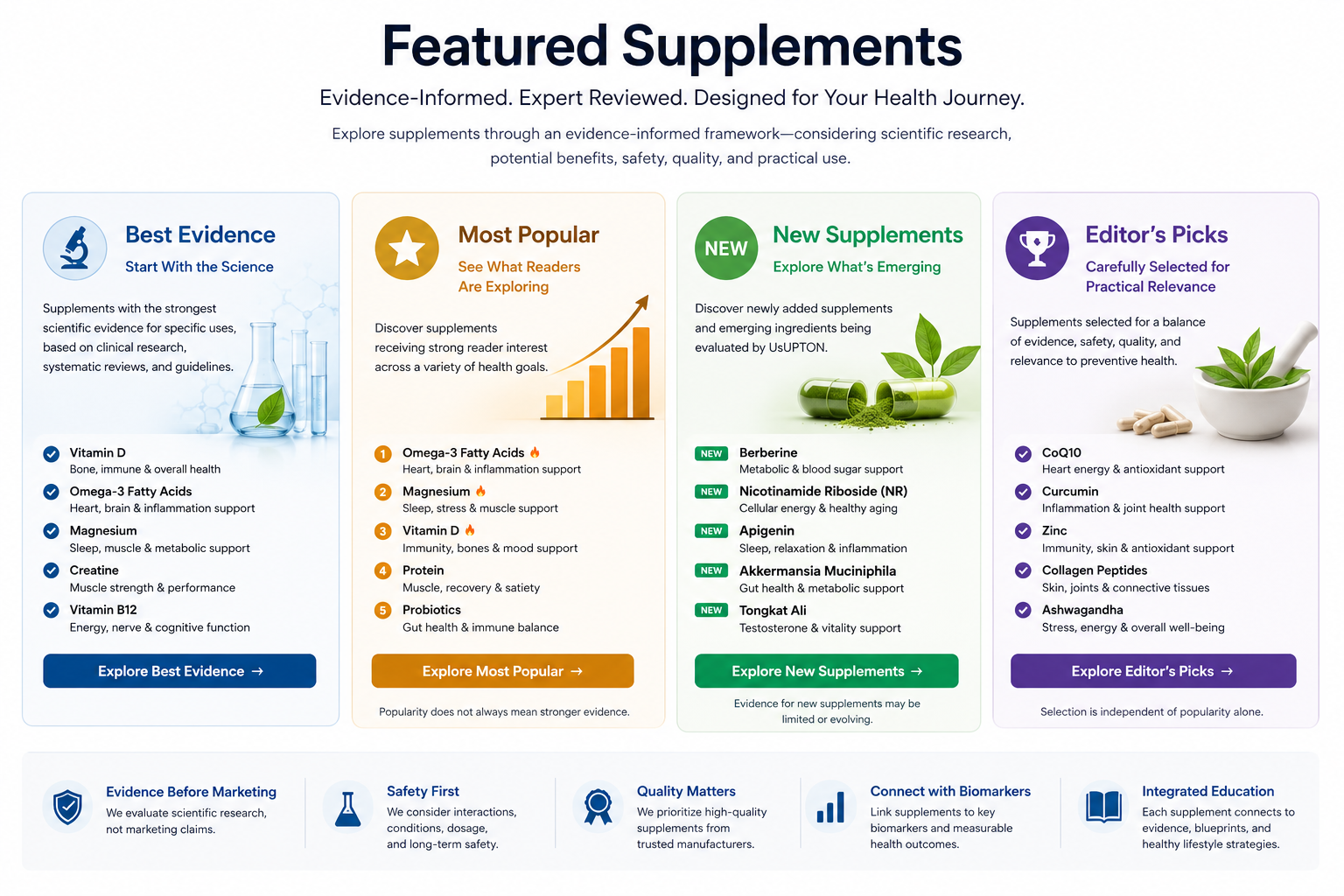
Explore supplements with comparatively stronger scientific evidence for specific uses, based on clinical research, systematic reviews, guidelines, and established nutritional science.
Each review considers:
Evidence Strength → Potential Benefits → Appropriate Use → Safety → Practical Considerations
Topics may include:
- Vitamin D
- Omega-3 Fatty Acids
- Creatine
- Protein
- Fiber
- Vitamin B12
- Folate
- Calcium
- Iron
- Magnesium
Explore Best Evidence →
⭐ Most Popular
See What Readers Are Exploring
Discover supplements receiving strong reader interest across nutrition, metabolic health, brain health, heart health, sleep, exercise, healthy aging, and longevity.
Popularity does not necessarily mean stronger scientific evidence. Products and ingredients should still be evaluated individually for effectiveness and safety.
Explore Most Popular →
🆕 New Supplements
Explore What’s Emerging
Discover newly added supplement reviews and emerging ingredients being evaluated by UsUPTON.
This section can cover developments in:
Healthy Aging · Metabolic Health · Brain Health · Heart Health · Sleep · Exercise · Nutrition · Gut Health
Evidence for newer supplements may be limited or evolving, and reviews should clearly distinguish promising research from established clinical evidence.
Explore New Supplements →
🏆 Editor’s Picks
Carefully Selected for Practical Relevance
Editor’s Picks highlight supplements that stand out based on a combination of scientific evidence, practical usefulness, safety considerations, product quality, and relevance to preventive health.
Selection should remain independent of popularity alone.
Explore Editor’s Picks →
Browse by Health Goal
What Would You Like to Support?
Organize the supplement library around reader goals:
Healthy Aging
Brain Health
Heart Health
Metabolic Health
Bone Health
Muscle Health
Sleep & Recovery
Digestive Health
Immune Health
Healthy Nutrition
Browse by Health Goal →
Browse by Supplement Type
Readers can also explore by ingredient category:
Vitamins → Minerals → Omega-3 & Fatty Acids → Protein & Amino Acids → Fiber & Prebiotics → Probiotics → Botanical Supplements → Sports Nutrition → Healthy Aging Supplements
This layer will work especially well with the Taxonomy system we’re building.
How We Evaluate Supplements
Evidence Before Marketing
I recommend making this one of the strongest sections on the page.
Scientific Literature
        ↓
Systematic Reviews
        ↓
Clinical Guidelines
        ↓
Evidence Evaluation
        ↓
Potential Benefits
        ↓
Safety & Interactions
        ↓
Product Quality
        ↓
Practical Guidance
Every supplement review should answer four simple questions:
Does it work? → Who might benefit? → Is it safe? → How strong is the evidence?
Supplement Evidence Rating
This would differentiate UsUPTON considerably.
★★★★★ Strong Evidence
Supported by substantial and consistent evidence for specified uses.
★★★★☆ Good Evidence
Supported by meaningful evidence, with some limitations.
★★★☆☆ Moderate Evidence
Potential benefit, but evidence remains mixed or incomplete.
★★☆☆☆ Limited Evidence
Early or inconsistent evidence.
★☆☆☆☆ Insufficient Evidence
Claims currently exceed available evidence.
Importantly, rate specific supplement–outcome pairs, not a supplement universally. For example, Vitamin D can have different evidence ratings for correcting deficiency versus preventing cardiovascular disease.
Safety First
Supplements are not automatically safe simply because they are available without a prescription.
Readers should consider:
Medication Interactions · Medical Conditions · Pregnancy · Kidney/Liver Function · Dose · Duration · Contamination · Third-Party Testing · Duplicate Ingredients
People taking medications, managing medical conditions, preparing for surgery, or considering high-dose supplementation should discuss appropriate use with a qualified healthcare professional.
Connect Supplements With Biomarkers
This is where the page can become part of the larger UsUPTON ecosystem rather than a conventional affiliate page.
For example:
Vitamin D
↓
25-Hydroxyvitamin D
↓
Bone Health
↓
Healthy Aging
↓
Related Blueprint
↓
Related Evidence
Or:
Omega-3
↓
Omega-3 Index
↓
Triglycerides
↓
Cardiovascular Health
↓
Heart Protection Blueprint
Eventually every supplement page can automatically connect to Biomarkers + Health Goals + Organs + Conditions + Blueprints + Evidence.
Related Resources
🧠 Knowledge Center — Understand vitamins, minerals, nutrition, metabolism, supplementation, deficiency, and preventive health.
🔬 Evidence Center — Explore research, systematic reviews, clinical guidelines, and evidence summaries behind supplement claims.
🧬 Biomarker Center — Understand measurable indicators that may help identify nutritional deficiencies and track relevant health outcomes.
📖 Blueprint Library — Connect supplement education with broader evidence-based strategies involving nutrition, exercise, sleep, screening, biomarkers, and healthy lifestyles.
A Smarter Way to Explore Supplements
Supplements should complement—not replace—nutritious food, physical activity, restorative sleep, preventive care, and appropriate medical treatment.
UsUPTON helps readers move beyond supplement marketing toward a more structured approach:
Evidence → Biomarkers → Safety → Personal Goals → Informed Decisions
Explore All Supplements →
🔬 Best Evidence | ⭐ Most Popular | 🆕 New Supplements | 🏆 Editor’s Picks