
Memory, Focus, and the Importance of Brain Recovery
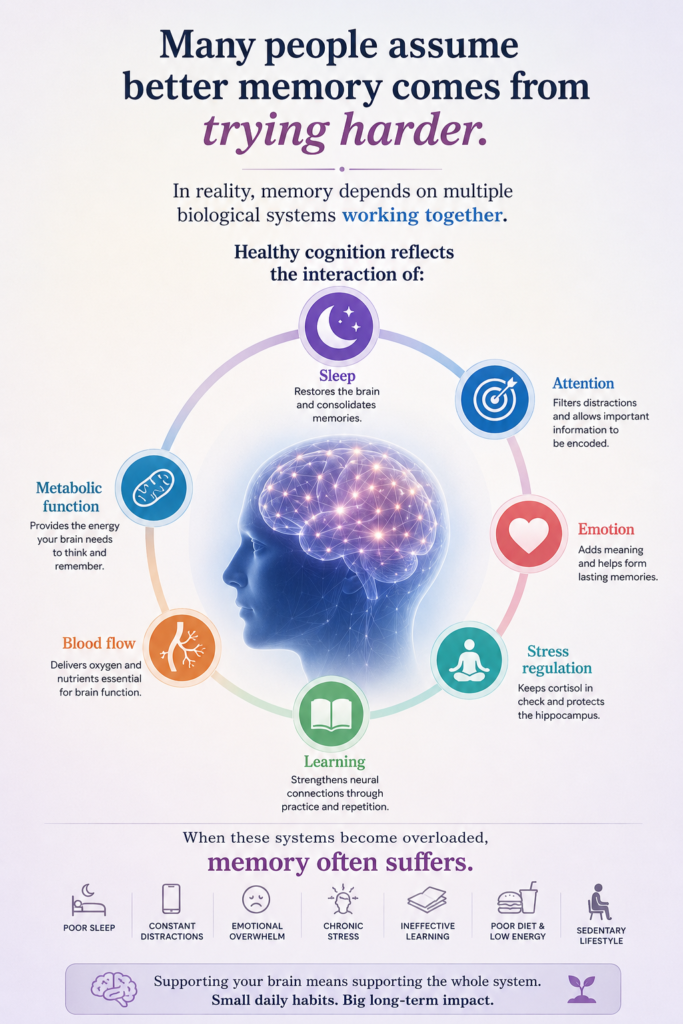
Many people assume better memory comes from trying harder.
In reality, memory depends on multiple biological systems working together.
Healthy cognition reflects the interaction of:
- Sleep
- Attention
- Emotion
- Stress regulation
- Learning
- Blood flow
- Metabolic function
When these systems become overloaded, memory often suffers.
Memory Is a Whole-System Function
Many people believe that improving memory simply requires trying harder, concentrating more intensely, or repeating information over and over. While focused practice certainly plays an important role in learning, modern neuroscience shows that memory is far more complex than willpower alone. Memory emerges from the coordinated activity of numerous biological systems that continuously communicate with one another. Rather than functioning as an isolated mental ability, memory reflects the overall health and efficiency of the brain and the body as an integrated network.
One of the most important contributors to memory is sleep. During healthy sleep, particularly deep sleep and rapid eye movement (REM) sleep, the brain organizes, strengthens, and consolidates newly acquired information. Experiences from the day are processed, unnecessary details are filtered, and important memories are stabilized into long-term storage. Inadequate or fragmented sleep can interfere with these processes, making it more difficult to learn new information or recall previously stored memories. Sleep also supports the removal of metabolic waste products from the brain, helping maintain an environment that promotes healthy cognitive function.
Attention is another essential component of memory formation. Information must first capture our attention before it can be effectively encoded by the brain. In today’s highly connected world, constant notifications, multitasking, and digital distractions compete for limited cognitive resources. When attention is repeatedly interrupted, the brain may struggle to fully process new experiences, reducing the likelihood that they will become lasting memories. Focused attention provides the foundation upon which successful learning and memory are built.
Memory is also closely connected with emotion. Emotional experiences often become more memorable because the brain assigns greater importance to events that carry personal meaning. Structures involved in emotional processing interact closely with memory-related regions, allowing emotionally significant experiences to be remembered more vividly. Positive emotions may enhance learning by increasing motivation and engagement, while chronic emotional distress may impair concentration and interfere with memory performance over time.
Closely related to emotion is stress regulation. Short periods of manageable stress can temporarily sharpen attention and improve performance. However, persistent psychological stress may have the opposite effect. Long-term elevation of stress hormones can interfere with communication between brain regions involved in learning and memory, particularly those responsible for forming and retrieving new memories. Supporting healthy stress management through relaxation practices, physical activity, social connection, and restorative sleep may help preserve cognitive resilience throughout life.
Memory also depends on continuous learning. The brain remains adaptable across the lifespan through a process known as neuroplasticity. Reading, practicing new skills, learning languages, solving problems, playing musical instruments, and engaging in intellectually stimulating activities encourage the formation and strengthening of neural connections. Regular mental challenges help maintain cognitive flexibility and support the brain’s remarkable capacity to adapt to changing environments.
Healthy blood flow provides another critical foundation for memory. The brain represents only a small percentage of total body weight, yet it consumes a substantial portion of the body’s oxygen and glucose supply. Efficient circulation delivers oxygen, nutrients, and other essential compounds needed for normal neuronal activity while removing metabolic waste products. Lifestyle habits that support cardiovascular health—including regular physical activity, balanced nutrition, healthy blood pressure, and avoidance of smoking—also contribute to long-term brain health.
Finally, metabolic function plays an essential role in cognitive performance. Every thought, memory, and neural signal requires energy. Stable glucose regulation, healthy mitochondrial function, and balanced metabolism help provide the continuous energy supply needed for normal brain activity. Metabolic dysfunction may contribute to fatigue, reduced concentration, and cognitive inefficiency, illustrating the close relationship between overall metabolic health and brain performance.
When these interconnected systems become overloaded—whether from poor sleep, chronic stress, physical inactivity, unhealthy nutrition, persistent distraction, or prolonged mental fatigue—memory often begins to suffer. Difficulties with attention, slower learning, forgetfulness, and reduced mental clarity frequently reflect the cumulative effects of multiple biological factors rather than a single isolated problem.
Understanding memory from a systems biology perspective shifts the focus away from searching for a single solution. Instead, it highlights the importance of supporting the entire network that enables healthy cognition. Consistent sleep, regular exercise, nutritious eating patterns, lifelong learning, stress management, cardiovascular health, and sustained attention work together to create an environment in which memory can perform at its best. Healthy cognition is not produced by one organ or one habit alone—it is the result of many interconnected systems working together every day.
Memory Begins with Attention
The brain cannot remember information that it never fully processes.
Distractions interrupt encoding.
Constant multitasking divides cognitive resources.
Switching between tasks repeatedly increases mental effort while reducing efficiency.
Creating moments of focused attention improves the foundation upon which memory is built.
Relaxation Supports Learning
Stress hormones play useful roles during short-term challenges.
Chronically elevated stress, however, may interfere with attention and memory formation.
Relaxation practices encourage conditions that may support healthier cognitive function.
The Brain Song™ provides structured opportunities to disconnect from external demands and reconnect with intentional awareness.
Building a Brain-Friendly Lifestyle
Audio wellness works best when combined with healthy daily habits.

These four concept illustrations present The Brain Song™ as a modern, systems-based audio wellness experience that integrates neuroscience, technology, and human-centered design. Although each image uses a different artistic style, they all communicate the same central message: brain health is not governed by a single process but emerges from the interaction of multiple biological systems working together. The glowing neural networks, holographic brain models, and circular interface designs symbolize communication pathways linking cognition, emotion, attention, memory, stress regulation, and energy metabolism into one interconnected system.
The first image emphasizes clarity and education, portraying The Brain Song™ as an accessible learning platform that translates complex neuroscience into practical daily wellness habits. The second image introduces a futuristic laboratory environment, highlighting scientific precision and systems biology through an advanced digital brain interface that represents real-time communication among neural networks. The third illustration focuses on the user experience, showing an individual immersed in sound while surrounded by dynamic information pathways, suggesting how immersive audio may encourage relaxation, attention, and cognitive engagement. The fourth image adopts a more artistic and emotional perspective, combining music, neural visualization, and elegant interface elements to communicate the harmony between science, technology, and personal well-being.
Together, the collection conveys a consistent vision of The Brain Song™ as more than a collection of relaxing sounds. Instead, it presents an educational framework inspired by systems neuroscience, where healthy cognition is supported through the interaction of sleep, attention, emotional balance, learning, stress management, circulation, and metabolic health. The futuristic visual language reinforces themes of innovation, preventive health, and personalized wellness while inviting viewers to explore the brain as a dynamic, adaptive network. Rather than promising medical treatment or cognitive enhancement, these illustrations position The Brain Song™ as a science-inspired audio wellness experience that encourages mindful listening, supports relaxation, and promotes a deeper understanding of the interconnected biological systems that contribute to lifelong brain health and healthy cognitive aging.
Helpful strategies include:
Consistent sleep schedules
Regular walking
Resistance training
Meditation
Balanced nutrition
Hydration
Reading
Social engagement
Nature exposure
Together, these behaviors create a supportive environment for long-term cognitive resilience.
Small Daily Practices Matter
Improving brain health rarely requires dramatic change.
Five minutes of intentional relaxation today becomes ten minutes tomorrow.
Repeated consistently, these moments become habits.
Habits become routines.
Routines become lifestyle.
Long-term cognitive wellness is built through thousands of small choices rather than one extraordinary intervention.
Ready to experience The Brain Song™ for yourself?
Understanding the science is only the beginning. The true value of audio wellness emerges through consistent practice. Explore how The Brain Song™ can become part of your daily rhythm—supporting moments of focus, emotional balance, cognitive relaxation, and mental recovery through intentional listening habits.