
The Connection Between Hearing and Brain Health
The ears collect sound—but the brain creates hearing.
Every conversation requires remarkable coordination between multiple brain regions that process language, memory, attention, and auditory information simultaneously.
Healthy hearing therefore depends on:
- Efficient neural communication
- Healthy blood circulation
- Mitochondrial energy production
- Neuroplasticity
- Cognitive processing
- Adequate sleep
- Balanced stress responses
The Brain Creates Hearing: A Whole-Brain Perspective on Healthy Hearing
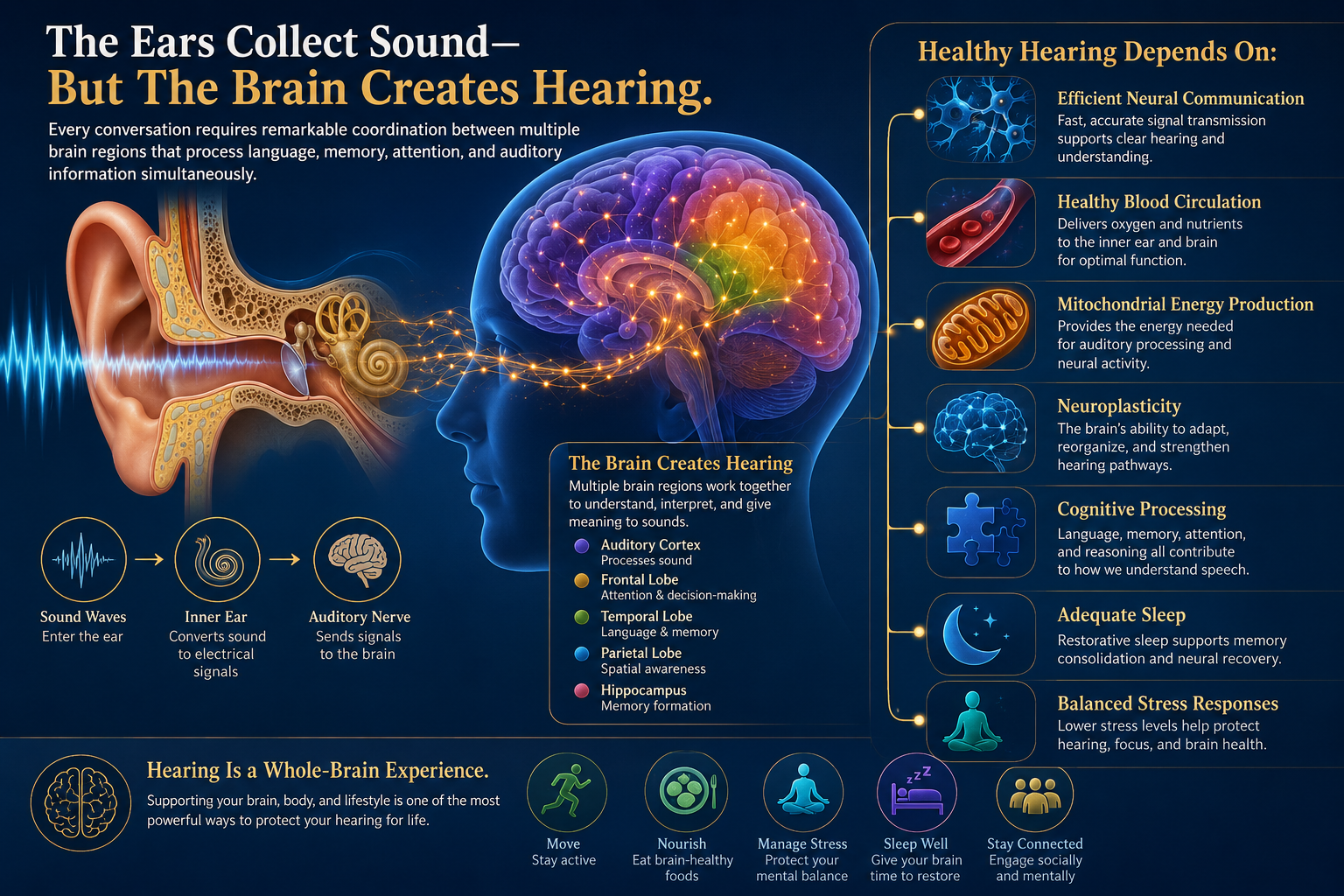
Many people think hearing begins and ends with the ears. In reality, the ears are only the first step in an extraordinary biological process. The ears collect sound waves from the environment, but the brain is responsible for transforming those signals into meaningful speech, music, and environmental awareness. Hearing is therefore not simply an ear function—it is a whole-brain function that depends on the coordination of multiple biological systems.
When sound enters the ear, it travels through the outer ear and vibrates the eardrum. These vibrations move through the tiny bones of the middle ear before reaching the cochlea in the inner ear. Inside the cochlea, thousands of specialized sensory hair cells convert mechanical vibrations into electrical signals. These signals travel through the auditory nerve to the brain, where true hearing begins.
The auditory cortex, located within the temporal lobe, serves as one of the brain’s primary centers for sound processing. However, understanding a conversation requires much more than auditory perception alone. The brain rapidly integrates information from numerous regions simultaneously. Language centers decode words and grammar, memory networks compare incoming sounds with stored experiences, attention systems help focus on important voices while filtering background noise, and executive brain regions interpret meaning and guide appropriate responses.
This remarkable coordination occurs within fractions of a second. Every conversation reflects one of the most complex examples of systems biology in daily life.
Healthy neural communication is essential for this process. Billions of neurons constantly exchange electrical and chemical signals through highly organized neural networks. Efficient communication allows the brain to distinguish subtle differences in speech sounds, recognize familiar voices, appreciate music, and respond quickly to changing environments. When communication between neurons becomes less efficient, auditory processing may become more difficult even when the ears themselves remain relatively healthy.
Healthy blood circulation also plays a fundamental role. The cochlea and brain require a continuous supply of oxygen and nutrients to maintain normal function. Although the inner ear is extremely small, it has significant metabolic demands. Even modest reductions in blood flow may influence the delicate sensory structures responsible for hearing. Likewise, the brain depends on healthy circulation to support auditory processing, attention, memory, and cognitive performance.
Mitochondria, often described as the energy-producing structures within cells, provide another critical foundation for hearing. Hair cells in the cochlea and neurons throughout the auditory pathways require substantial amounts of energy to generate electrical signals continuously throughout the day. Supporting overall metabolic health—including regular physical activity, balanced nutrition, and adequate recovery—may help maintain healthy cellular energy production across these systems.
Neuroplasticity further demonstrates that hearing remains dynamic throughout life. The brain continually adapts its neural connections based on experience and learning. Individuals learning a new language, practicing music, or using hearing rehabilitation strategies often demonstrate measurable changes within auditory brain networks. This adaptability highlights the brain’s remarkable ability to strengthen communication pathways when appropriately stimulated.
Cognitive processing also contributes significantly to hearing performance. Listening involves far more than detecting sounds. The brain must organize speech, interpret emotional tone, recall vocabulary, recognize familiar patterns, and predict what someone is likely to say next. As a result, memory, attention, executive function, and processing speed all influence everyday communication. This is one reason why some individuals with normal hearing tests may still report difficulty understanding speech in noisy environments.
Lifestyle factors strongly influence these interconnected systems. Quality sleep supports memory consolidation, neural recovery, and synaptic maintenance, allowing the brain to process auditory information more efficiently the following day. Chronic sleep deprivation may reduce attention, slow information processing, and increase mental fatigue, making conversations feel more difficult even when hearing sensitivity remains unchanged.
Stress also affects hearing through multiple biological pathways. Persistent stress activates the body’s stress response, increasing sympathetic nervous system activity and altering hormone regulation. Over time, chronic stress may influence concentration, cognitive performance, sleep quality, and overall nervous system balance. Managing stress through relaxation techniques, regular exercise, mindfulness, and social connection may therefore support both brain health and auditory function.
Ultimately, healthy hearing reflects the integration of the ears, brain, cardiovascular system, metabolism, sleep, cognition, and emotional well-being. Rather than viewing hearing as an isolated sensory function, modern neuroscience increasingly recognizes it as a whole-body process. Protecting hearing is therefore not only about reducing noise exposure—it also involves supporting lifelong brain health, healthy circulation, regular movement, restorative sleep, balanced nutrition, and effective stress management. Small daily habits that strengthen these interconnected biological systems may help preserve communication, cognitive function, and quality of life for years to come.
When hearing becomes more difficult, the brain must work harder to interpret incomplete sound information. This increased listening effort may contribute to mental fatigue during long conversations or noisy social environments.
Researchers continue exploring relationships between hearing, cognitive function, social engagement, and healthy aging. While hearing changes do not directly cause cognitive decline, maintaining auditory health may help support communication, mental stimulation, and overall quality of life.
Nutrition, Brain Health, and the Science of Hearing

The illustration presents a modern systems biology perspective on hearing health, emphasizing that healthy hearing extends far beyond the ear itself. Each visual combines the ear with nutrient-rich foods, botanical ingredients, neural imagery, and advanced scientific graphics to symbolize the interconnected relationship between nutrition, brain function, metabolism, and auditory wellness. Rather than portraying hearing as an isolated sensory process, the artwork highlights the body as an integrated biological network.
Colorful fruits, vegetables, herbs, nuts, and seeds represent dietary patterns rich in vitamins, minerals, antioxidants, and plant compounds that support overall cellular health. These nutrients help maintain healthy circulation, reduce oxidative stress, and provide the building blocks needed for normal nervous system function. The subtle inclusion of brain imagery reinforces the idea that hearing depends not only on the ears but also on efficient communication throughout the auditory pathways and cognitive centers of the brain.
The clean white background and futuristic medical interface convey precision medicine and evidence-informed preventive healthcare. Floating molecular elements and digital graphics symbolize advances in neuroscience, nutrition research, and personalized wellness. Together, the four designs communicate that protecting hearing involves supporting the entire biological system through balanced nutrition, healthy blood flow, mitochondrial energy production, quality sleep, stress management, and lifelong brain health. The artwork reflects a prevention-first philosophy in which small, consistent lifestyle choices contribute to healthier hearing, cognitive resilience, and long-term healthy aging.
How the Brain Creates Sound Meaning?

This four-panel illustration explores hearing through the lens of systems biology, neuroscience, and modern urban life. Rather than depicting hearing as a simple function of the ear, the artwork emphasizes that hearing is an active process involving the brain, attention, cognition, and the surrounding environment. Each panel presents a different perspective on how humans perceive and interpret sound in an increasingly complex world.
The first image places a giant ear within a futuristic smart city, symbolizing the constant flow of information that modern individuals encounter every day. The second panel shifts the focus to the listener, illustrating how the brain transforms sound into meaningful experiences through perception, memory, and emotion. The glowing neural patterns suggest active communication between auditory pathways and higher cognitive centers.
In the third panel, people gather around an oversized ear, representing communication, social interaction, and the importance of hearing in connecting individuals and communities. The final image portrays a listener wearing headphones surrounded by vibrant waves of sound and neural energy, highlighting the intimate relationship between music, auditory stimulation, and brain function.
Together, these images communicate that healthy hearing depends on far more than the ears alone. Brain health, attention, emotional well-being, neural communication, and environmental awareness all contribute to how we experience sound. The artwork reflects a prevention-first philosophy, encouraging support for the entire auditory-brain system through healthy lifestyle habits, cognitive engagement, stress management, and lifelong learning.
The Hearing Support Blueprint explores these connections through an educational, evidence-informed perspective.
Ready to take the next step? Explore practical strategies and evidence-based approaches designed to support hearing health, cognitive wellness, and healthy aging. Small actions today may help preserve the connections that matter most tomorrow.