
Why Metabolism Matters More Than Weight
Metabolism Reset Blueprint
A Smarter, More Sustainable Approach to Metabolic Health
For decades, health conversations have focused almost exclusively on body weight. Millions of people step onto a scale every morning believing that the number they see determines whether they are healthy or unhealthy. Yet modern science paints a much more complex picture.
Metabolic health extends far beyond body size. It represents the body’s ability to efficiently produce energy, regulate blood sugar, balance hormones, manage inflammation, and support every organ system from the brain to the heart.
Someone can have a “normal” weight while experiencing insulin resistance, chronic inflammation, poor sleep, and low energy. Likewise, an individual carrying extra weight may still possess relatively healthy metabolic function.
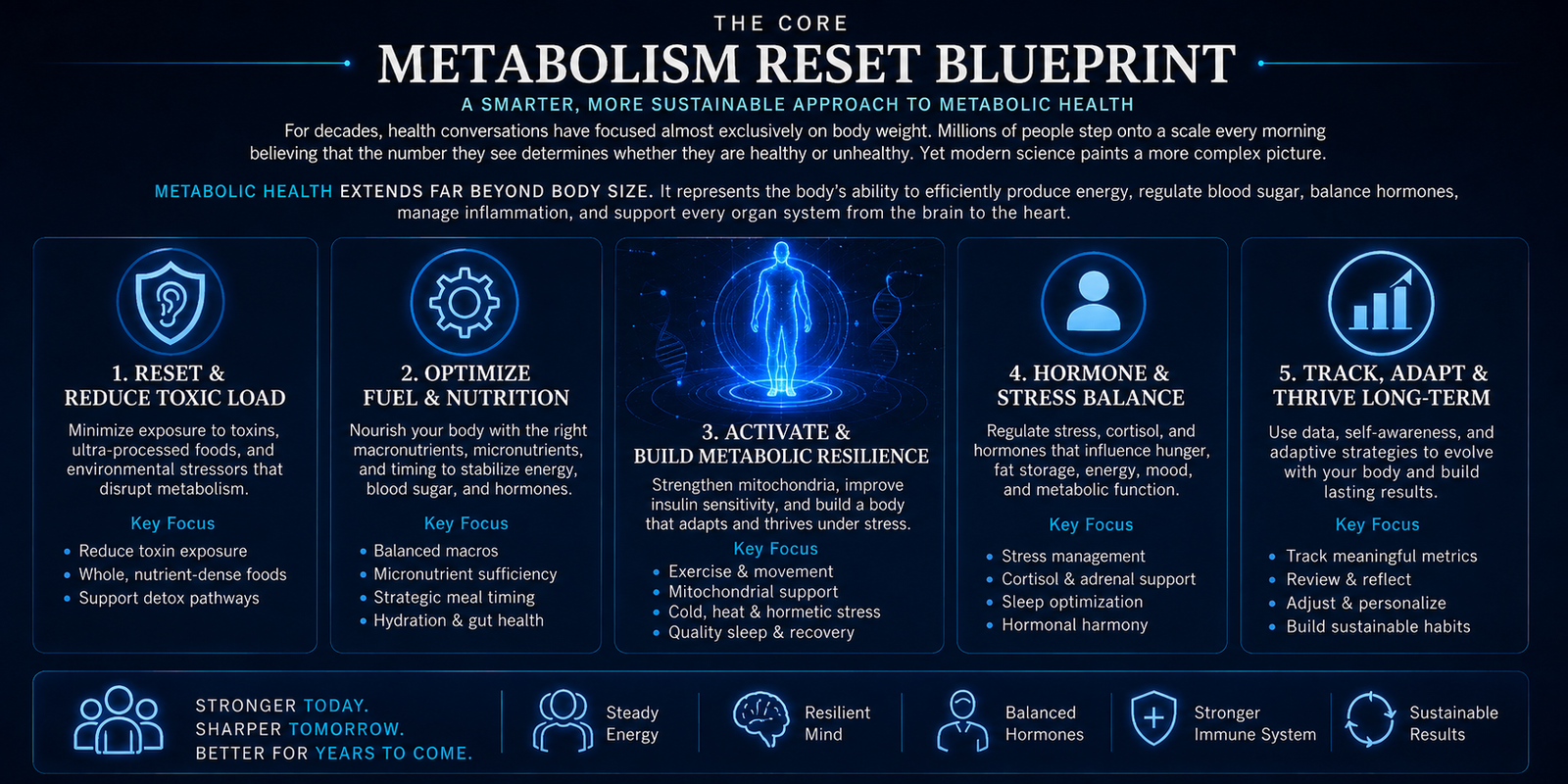
Figure 1. Metabolism Reset Blueprint
A Smarter, More Sustainable Approach to Metabolic Health
For decades, health conversations have centered almost entirely on body weight. Many people judge their health by a single number on the scale, believing that losing weight is the ultimate goal. However, modern metabolic science reveals a much broader and more meaningful perspective.
Metabolic health is the foundation that powers every cell, tissue, and organ in the body. It reflects how efficiently the body converts nutrients into energy, regulates blood sugar, balances hormones, manages inflammation, and maintains communication between the brain, muscles, liver, heart, and immune system. A healthy metabolism supports vitality, resilience, and longevity—not simply a lower body weight.
The Metabolism Reset Blueprint presents a practical, systems-based approach built around five interconnected pillars.
1. Reset & Reduce Toxic Load
Modern lifestyles expose the body to excessive processed foods, environmental pollutants, chronic stress, and poor sleep habits that may disrupt normal metabolic function. Reducing these burdens creates a healthier biological environment and supports the body’s natural regulatory systems.
Key Focus
- Reduce exposure to ultra-processed foods
- Emphasize whole, nutrient-dense nutrition
- Support natural detoxification pathways
- Build healthier daily habits
2. Optimize Fuel & Nutrition
The body requires consistent, high-quality fuel to maintain stable energy production and metabolic flexibility. Rather than restrictive dieting, sustainable nutrition focuses on balanced meals rich in protein, healthy fats, fiber, vitamins, and minerals.
Key Focus
- Balanced macronutrients
- Micronutrient sufficiency
- Strategic meal timing
- Hydration and gut health
3. Activate & Build Metabolic Resilience
Movement is one of the most powerful metabolic interventions available. Regular exercise strengthens mitochondria, improves insulin sensitivity, preserves muscle mass, and increases the body’s ability to adapt to physical and mental stress.
Key Focus
- Daily movement and resistance training
- Mitochondrial support
- Metabolic flexibility
- Quality sleep and recovery
4. Hormone & Stress Balance
Hormones coordinate nearly every metabolic process, including appetite regulation, energy production, fat storage, and blood sugar control. Chronic stress and elevated cortisol can disrupt these systems, making long-term health more difficult to achieve.
Key Focus
- Stress management
- Cortisol regulation
- Sleep optimization
- Hormonal harmony
5. Track, Adapt & Thrive Long-Term
Lasting metabolic health comes from continuous learning and gradual adjustment rather than short-term perfection. Monitoring meaningful indicators allows individuals to personalize their strategies and build sustainable habits over time.
Key Focus
- Track meaningful health metrics
- Review progress regularly
- Personalize interventions
- Build lifelong healthy routines
The Bigger Picture
A successful metabolism reset is not a quick fix or a temporary diet. It is the process of restoring the body’s ability to efficiently produce energy, regulate glucose, maintain hormonal balance, and recover from daily stressors.
When these biological systems work together, many people experience:
- More consistent energy
- Better blood sugar stability
- Improved mental clarity
- Enhanced physical performance
- Stronger immune resilience
- Greater long-term well-being
Stronger Today. Sharper Tomorrow. Better for Years to Come.
By focusing on sustainable lifestyle practices instead of chasing rapid weight loss, the Metabolism Reset Blueprint offers a realistic and evidence-informed pathway toward lifelong metabolic health, resilience, and healthy aging.
The real objective is not simply becoming thinner.
The goal is becoming metabolically resilient.
What Is Metabolism?
Metabolism refers to the countless chemical reactions occurring inside every cell every second.
These reactions allow us to:
- Convert food into energy
- Build muscle
- Repair tissues
- Regulate hormones
- Support brain function
- Maintain body temperature
- Eliminate waste products

Figure 2. What Is Metabolism?
Metabolism is the extraordinary network of chemical reactions taking place inside every cell of the human body every second of every day. Far from being a simple measure of how quickly calories are burned, metabolism is the fundamental biological system that produces energy, maintains life, and coordinates communication between organs.
Every heartbeat, every breath, every thought, and every movement depends on metabolic processes that convert nutrients into usable cellular energy. Thousands of enzymes, hormones, mitochondria, and signaling molecules work together continuously to keep the body functioning in balance.
A healthy metabolism enables us to:
- Convert food into cellular energy that powers muscles, organs, and every biological process
- Build and maintain muscle tissue through continuous protein synthesis and repair
- Repair damaged cells and tissues to support recovery and healthy aging
- Regulate hormones that influence appetite, stress response, growth, and reproduction
- Support brain function by providing a constant supply of glucose and oxygen for memory, focus, and cognition
- Maintain body temperature through carefully controlled energy production and heat generation
- Eliminate waste products and recycle cellular components to preserve internal balance
Rather than operating as a single pathway, metabolism is an interconnected system linking the digestive tract, liver, pancreas, muscles, brain, heart, immune system, and endocrine organs. When these systems work together efficiently, the body maintains stable energy levels, balanced blood sugar, healthy inflammation responses, and optimal physical and mental performance.
This systems-based perspective explains why metabolic health influences far more than body weight. It affects vitality, resilience, sleep quality, cognitive function, cardiovascular health, immune regulation, and long-term longevity.
Ultimately, metabolism is the body’s biological engine—a dynamic network that transforms nutrition into life itself. Supporting metabolic health through balanced nutrition, regular movement, quality sleep, stress management, and sustainable lifestyle habits helps create the foundation for lifelong wellness, stronger daily performance, and healthy aging.
Rather than operating like a single engine, metabolism resembles an interconnected city where multiple systems communicate continuously.
These include:
- The brain
- Liver
- Muscles
- Fat tissue
- Pancreas
- Gut microbiome
- Hormonal system
- Immune system
When communication between these systems remains efficient, energy is produced smoothly and the body adapts effectively to everyday challenges.
Why Modern Life Challenges Metabolism
Human biology evolved over thousands of years.
Modern lifestyles changed dramatically within only a few generations.
Today many people experience:
- Prolonged sitting
- Sleep deprivation
- Chronic stress
- Ultra-processed foods
- Constant screen exposure
- Reduced physical activity
- Social isolation
Each factor may influence metabolic regulation.
Instead of viewing weight gain as a personal failure, a systems perspective recognizes that biology continuously responds to environmental conditions.
The body adapts.
Sometimes those adaptations become protective in the short term but problematic over many years.
The Metabolic Domino Effect
Poor sleep may increase stress hormones.
Higher stress hormones may increase cravings.
More cravings may encourage overeating.
Overeating may worsen blood sugar regulation.
Blood sugar instability may reduce energy.
Low energy often reduces physical activity.
Reduced activity decreases muscle stimulation.
Lower muscle activity may reduce glucose utilization.
The cycle repeats.
Breaking this cycle does not require perfection.
Small improvements in multiple areas often create powerful cumulative effects.
A Better Goal
Instead of asking:
“How can I lose weight quickly?”
Consider asking:
“How can I create conditions that allow my metabolism to function better?”
The difference is profound.
One focuses on punishment.
The other focuses on supporting human biology.
Long-term health is built through thousands of daily decisions rather than one dramatic intervention.

Figure 3. How Can I Lose Weight Quickly?
Many people begin their health journey with one question:
“How can I lose weight quickly?”
While understandable, this question often leads toward restrictive diets, excessive exercise, and short-term solutions that are difficult to sustain. Weight may temporarily decrease, but the body frequently responds by increasing hunger, slowing energy expenditure, and making long-term maintenance more challenging.
A more productive question is:
“How can I create conditions that allow my metabolism to function better?”
This subtle shift changes the entire philosophy of health.
From Restriction to Support
Instead of fighting the body, a metabolism-centered approach works with human biology.
Rather than focusing on:
- Counting every calorie
- Eliminating entire food groups
- Exercising to exhaustion
- Chasing rapid weight loss
it emphasizes creating an internal environment that naturally supports energy balance.
This includes:
✓ Stable blood sugar
✓ Healthy muscle mass
✓ Quality sleep
✓ Stress regulation
✓ Adequate protein intake
✓ Daily movement
✓ Recovery and hydration
These factors influence hormones such as insulin, cortisol, leptin, and ghrelin, which collectively regulate appetite, energy use, and fat storage.
The Difference Is Profound
Punishment Mindset
“I need to eat less.”
“I have to burn more calories.”
“I failed because the scale didn’t move.”
This mindset often creates cycles of restriction, cravings, guilt, and rebound weight gain.
Biology-Support Mindset
“How can I nourish my body?”
“How can I improve my energy?”
“How can I build habits that support metabolic resilience?”
The goal becomes better health rather than constant self-punishment.
Small Daily Decisions Create Big Results
Long-term metabolic health is rarely built through one dramatic intervention.
Instead, it develops through thousands of small choices repeated consistently.
Examples include:
- Walking after meals
- Eating more vegetables and protein
- Drinking enough water
- Going to bed at a consistent time
- Strength training two or three times per week
- Taking regular breaks from chronic stress
- Spending time outdoors
Each action may seem modest, but together they create a biological environment that supports healthier metabolism.
Sustainable Progress Beats Rapid Loss
Rapid weight loss often reflects temporary reductions in water, glycogen, or muscle tissue rather than lasting improvements in metabolic function.
Sustainable progress focuses on:
- Better energy throughout the day
- Improved blood sugar regulation
- Increased strength
- Reduced cravings
- Better sleep quality
- Improved mood and concentration
- Gradual body composition changes
These improvements often precede visible changes on the scale and are strong indicators of better overall health.
A Systems-Based Perspective
The human body is an interconnected system rather than a simple calorie calculator.
Sleep affects hunger hormones.
Stress influences food choices.
Muscle supports glucose regulation.
Movement improves insulin sensitivity.
Nutrition fuels recovery.
Each system strengthens the others.
When these systems work together, maintaining a healthy weight becomes less about willpower and more about supporting normal human physiology.
Final Takeaway
The question:
“How can I lose weight quickly?”
often leads to short-term solutions.
A more powerful question is:
“How can I create conditions that allow my metabolism to function better?”
The difference is profound.
One focuses on punishment.
The other focuses on supporting human biology.
And lasting health is rarely created by one dramatic change—it is built through thousands of thoughtful daily decisions that, over time, allow the body to become stronger, more resilient, and better able to regulate itself naturally.
The Metabolism Reset Blueprint embraces consistency over extremes, resilience over restriction, and sustainable habits over temporary solutions.
Small metabolic improvements repeated consistently over time may create powerful long-term changes in energy, appetite control, and body composition.