
Why Short-Term Weight Loss Often Works
Why Early Weight Loss Happens So Quickly
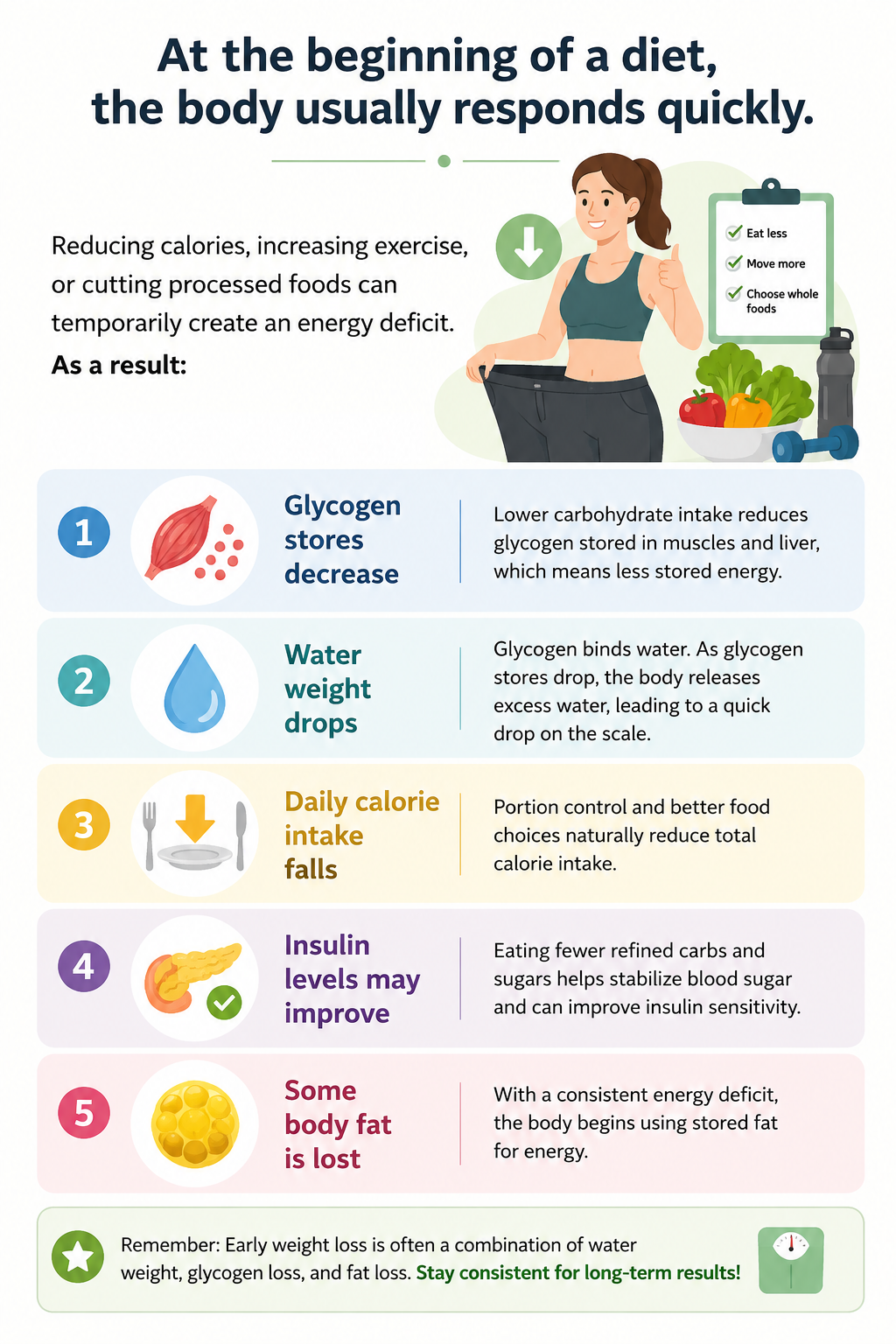
Many people experience encouraging results during the first few weeks of a new diet or healthy lifestyle program. This early progress is driven by several normal physiological changes rather than body fat loss alone. When calorie intake decreases and physical activity increases, the body begins using stored glycogen—the carbohydrate reserve found primarily in the liver and muscles—for energy. Because glycogen is stored together with water, its depletion leads to a rapid reduction in water weight, often producing noticeable changes on the scale within days.
At the same time, eating fewer calories creates an energy deficit that encourages the body to gradually draw upon stored fat to meet its energy needs. Improvements in food quality, especially reducing refined carbohydrates and highly processed foods, may also support healthier insulin regulation and improve metabolic efficiency. These early adaptations represent the body’s natural response to a change in energy balance.
However, rapid initial weight loss does not continue indefinitely. As the body adapts, metabolism becomes more efficient and the rate of weight loss often slows. This transition is completely normal and should not be viewed as failure. Sustainable long-term success depends on maintaining healthy nutrition, regular physical activity, adequate sleep, stress management, and consistent lifestyle habits rather than expecting continuous rapid weight loss.
At the beginning of a diet, the body usually responds quickly.
Reducing calories, increasing exercise, or cutting processed foods can temporarily create an energy deficit. As a result:
- Glycogen stores decrease
- Water weight drops
- Daily calorie intake falls
- Insulin levels may improve
- Some body fat is lost
This early phase can feel encouraging because the body is highly responsive to change.
Many people lose weight within the first few weeks of a structured program, especially if their previous diet contained excess sugar, refined carbohydrates, or ultra-processed foods.
However, early success does not always predict long-term sustainability.
The human body is biologically designed to protect itself from perceived energy shortages.
And this is where a major challenge begins.
Why the Body Starts Adapting?
Why the Body Begins to Adapt During Weight Loss
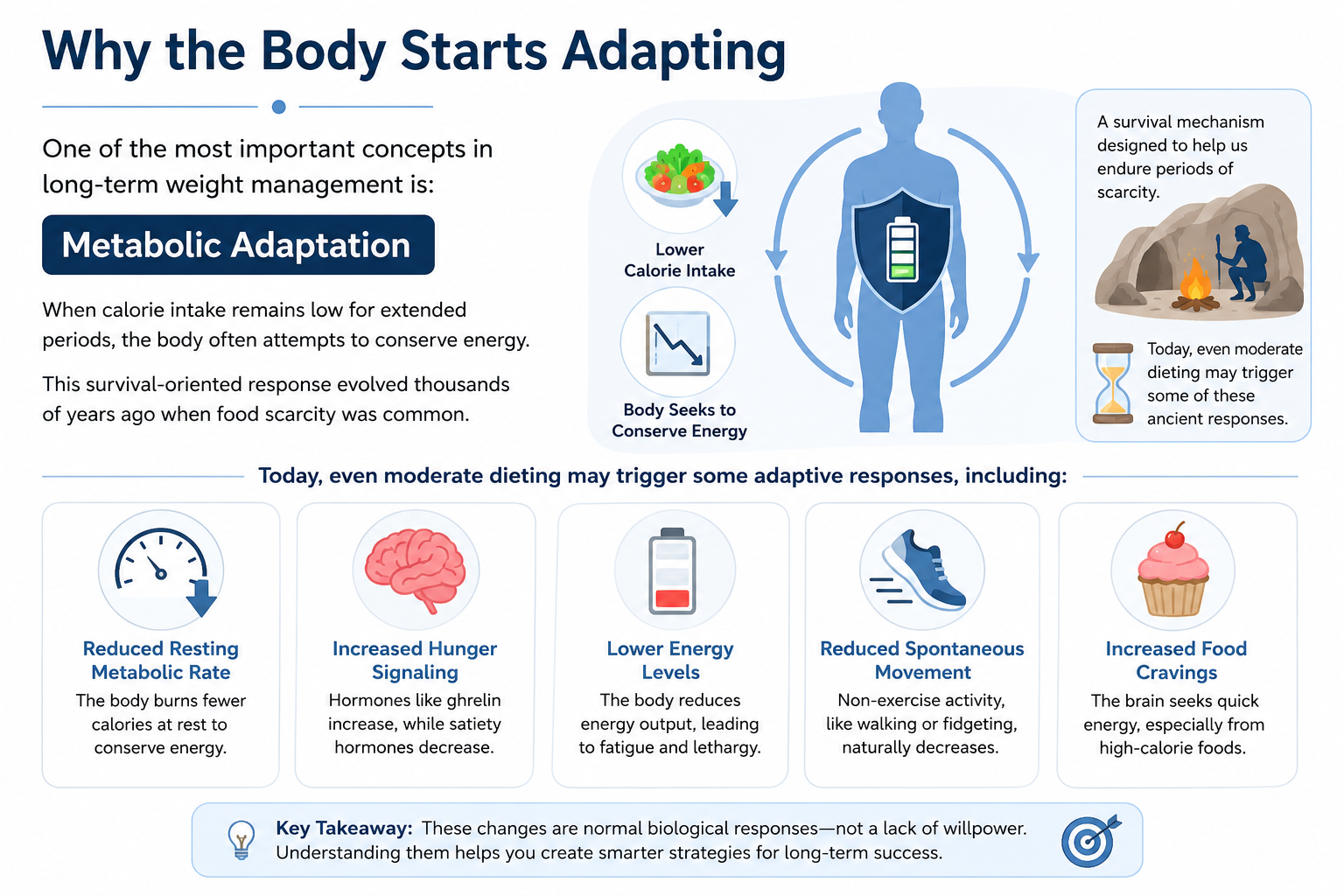
One of the most important concepts in long-term weight management is metabolic adaptation. The human body evolved to survive periods of food scarcity, and when calorie intake remains reduced for an extended time, it naturally begins conserving energy. Although this response once protected our ancestors from starvation, it can make sustained weight loss more challenging in today’s environment.
As energy intake declines, resting metabolic rate may decrease, meaning the body burns fewer calories even while at rest. Hormones involved in appetite regulation also change. Hunger-promoting signals often increase, while feelings of fullness may become less pronounced. Many people notice reduced energy, greater fatigue, and less spontaneous movement throughout the day, which further lowers total daily energy expenditure. At the same time, cravings for energy-dense, highly palatable foods may become stronger as the brain attempts to restore energy balance.
These biological adjustments are normal and do not indicate a lack of motivation or willpower. Rather, they reflect the body’s remarkable ability to maintain internal stability during periods of reduced energy availability. Understanding metabolic adaptation helps explain why weight loss commonly slows after the initial weeks of dieting. Sustainable success is therefore best achieved through gradual lifestyle changes that emphasize balanced nutrition, regular physical activity, adequate protein intake, strength training, quality sleep, stress management, and long-term consistency instead of extreme calorie restriction.
One of the most important concepts in long-term weight management is:
Metabolic Adaptation
When calorie intake remains low for extended periods, the body often attempts to conserve energy.
This survival-oriented response evolved thousands of years ago when food scarcity was common.
Today, even moderate dieting may trigger some adaptive responses, including:
- Reduced resting metabolic rate
- Increased hunger signaling
- Lower energy levels
- Reduced spontaneous movement
- Increased food cravings
The body is not “trying to sabotage” a person.
Instead, it is responding to biological signals that historically helped humans survive famine.
This is one reason many strict diets become increasingly difficult over time.
Stress, Cortisol, and Weight Regulation
Many weight loss discussions focus only on calories.
But chronic stress can also strongly influence body composition and eating behavior.
When stress becomes persistent, the body may produce elevated levels of cortisol, a hormone involved in survival responses.
Long-term cortisol elevation has been associated with:
- Increased appetite
- Emotional eating
- Sleep disruption
- Fat storage patterns
- Energy instability
- Reduced recovery
Poor sleep may further intensify the cycle.
Research increasingly suggests that inadequate sleep can affect:
- Hunger hormones
- Glucose regulation
- Cravings
- Energy levels
- Decision-making
This helps explain why highly restrictive programs often become harder to maintain under real-life conditions.
A sustainable approach typically requires more than simply “eating less.”
Why Extreme Dieting Often Backfires
Very restrictive programs may create short-term results but can become difficult to sustain psychologically and biologically.
Common issues include:
- Constant hunger
- Fatigue
- Social restriction
- Mood changes
- Loss of motivation
- Rebound overeating
Some individuals may also develop an “all-or-nothing” mindset:
“If I can’t do it perfectly, I’ve failed.”
Over time, this pattern may contribute to repeated cycles of weight loss and regain.
This phenomenon is sometimes called:
Weight Cycling
Long-term consistency is often more important than short periods of extreme restriction.
Building a More Sustainable Long-Term System

Modern preventive health approaches increasingly focus on sustainability rather than short-term intensity.
While individual needs vary, many evidence-based strategies emphasize:
Nutrient-Dense Eating
Focusing on minimally processed foods, adequate protein, fiber, and balanced meals.
Resistance Training
Maintaining muscle mass may support long-term metabolic health.
Sleep Optimization
Sleep quality plays a major role in recovery, appetite regulation, and energy balance.
Stress Regulation
Stress-management practices may help support healthier behavioral patterns.
Gradual Habit Change
Small, repeatable changes are often easier to maintain than highly restrictive protocols.
Systems Thinking
Weight regulation is connected to the entire body:
- Brain
- Hormones
- Gut health
- Sleep
- Inflammation
- Energy balance
Sustainable progress often comes from supporting multiple systems together.
Final Thoughts
Many weight loss programs fail long-term not because people are weak or lazy, but because human biology is incredibly adaptive.
The body responds dynamically to:
- Calorie restriction
- Stress
- Sleep disruption
- Hormonal changes
- Environmental pressures
Understanding these mechanisms may help shift the conversation away from blame and toward a more realistic, science-informed perspective.
Long-term health is rarely built through extreme short-term efforts alone.
It is usually built through sustainable systems, consistency, recovery, and evidence-based lifestyle support.
Explore Evidence-Based Metabolism Support Options
Start with the option that best matches your wellness goals. Castor oil packs offer an accessible introduction to external comfort and relaxation. If you’re ready to look beyond short-term relief and explore approaches designed to support deeper metabolic function and long-term wellness, additional evidence-based options are available below.
To learn more about metabolism, energy regulation, and science-based wellness strategies:
👉 Explore evidence-based metabolism support options: